
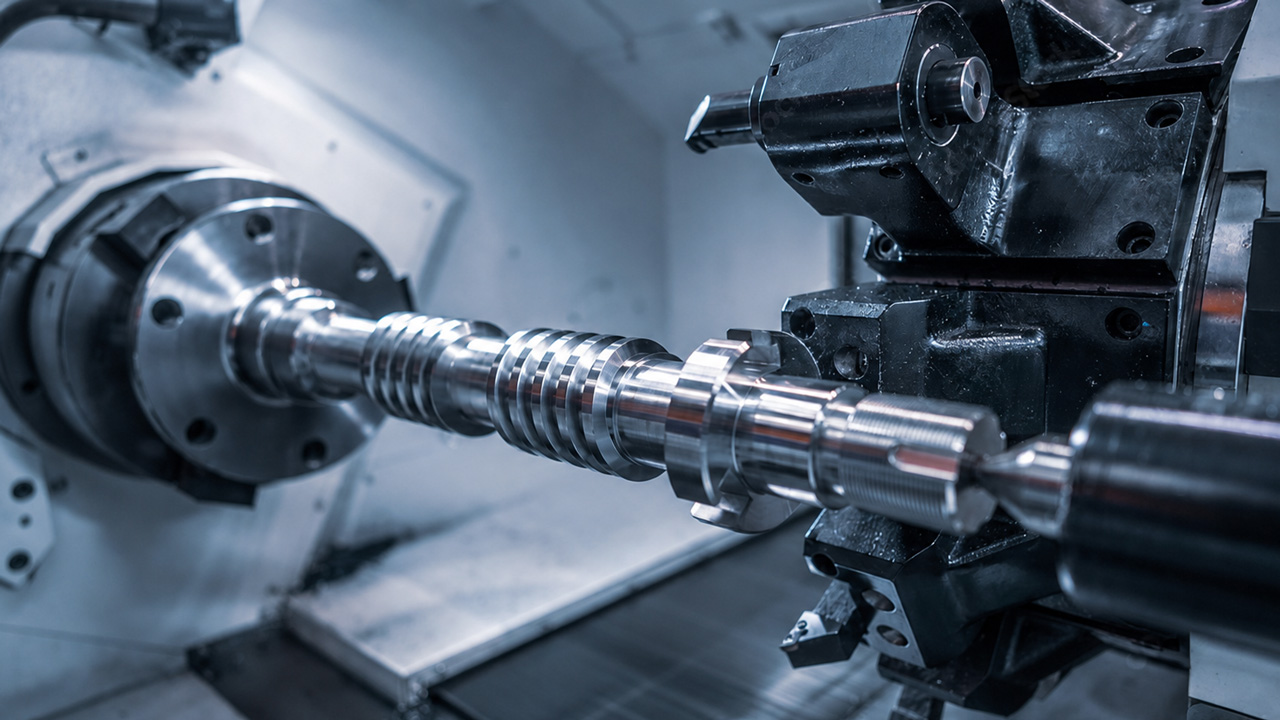
A machine tool is a machine that cuts or drills metal and other materials to produce parts of a desired shape.
There are many kinds of machine tools, and they can be grouped according to how they machine material.
This page organizes the typical machine tools from the standpoint of machining method and looks at each one's characteristics and strengths.
In This Article
Most Machine Tools Work by Removing Material
Most machine tools create the desired shape by removing unwanted material from a workpiece.
Based on how they cut, they can be broadly classified as follows.
Lathe-type machines (the workpiece rotates)
A lathe rotates the workpiece and cuts it by bringing a tool against it.
Because the tool is applied to rotating material, lathes excel at producing parts with round cross sections — cylinders, cones, and threads.
Typical examples include shafts, pins, bushings, and connector parts.
The CNC automatic lathe, the subject of this site, also belongs to this lathe family.
Milling-type machines (the tool rotates)
A milling machine works the opposite way: it rotates the cutting tool and brings it against the material.
It excels at machining non-round features such as flat surfaces, grooves, steps, and complex contours.
Its more advanced descendant is the machining center, discussed below.
Drill presses, grinders, and others
Some machines specialize in particular operations: the drill press, which drills holes; the grinder, which uses an abrasive wheel to finish surfaces to high precision; and the electrical discharge machine (EDM), which uses spark erosion to machine hard metals.
They handle drilling, high-precision finishing, and difficult-to-cut materials, respectively.
Lathe or Milling Machine: What Rotates?
The difference between lathes and milling machines is a common point of confusion for newcomers.
The simplest way to remember it: a lathe rotates the material; a milling machine rotates the tool.
The basic rule of thumb is lathes for round parts and milling machines for parts with many flat surfaces and grooves.
Multitasking Machines That Integrate Processes
In recent years, machines that handle both turning and milling in a single unit have become widespread.
The most typical example is the multitasking machine, such as the turning center.
Built on a lathe base and equipped with rotating tools, it can perform flat-surface machining and drilling as well as round work — all in a single setup.
Since fewer separate machines are needed, this leads to process integration and higher productivity.
CNC automatic lathes are moving in the same direction: advanced models offer simultaneous front and back machining and milling capability, taking on more of the character of a multitasking machine.
Quick Reference: Machining Methods and Typical Parts
The table below organizes the machine tool types introduced so far by the machining they do best and the parts they typically produce.
It is a useful first pass when narrowing down machine selection.
| Type | What rotates | Best-suited shapes | Typical parts |
|---|---|---|---|
| Lathe / CNC automatic lathe | The material | Round cross sections, shafts, threads | Shafts, pins, connectors, bushings |
| Milling machine / machining center | The tool | Flat surfaces, grooves, complex contours | Dies and molds, brackets, housings |
| Drill press | The drill | Holes | Hole-drilling operations of all kinds |
| Grinder | The grinding wheel | High-precision finished surfaces | Precision shafts, gauges, die/mold finishing |
| Multitasking machine | Both | Multiple faces, multiple processes | Complex parts requiring process integration |
How to Think About Choosing a Machine Tool
When deciding which machine tool your company needs, the starting point is what kind of parts you will make, and in what quantities.
For large volumes of small, slender, round parts, a lathe-type machine is the answer — and if you are aiming for volume production or unattended operation, a CNC automatic lathe is a strong candidate.
For block-shaped parts with many flat surfaces and grooves, a milling-type machine is the better fit.
If a single part requires both turning and milling, and high positional accuracy on top of that, a multitasking machine comes into consideration.
In short, the basic approach is to work backward from part geometry and production volume.
Rather than looking for a machine that simply does a bit of everything, choosing one matched to your core parts ultimately pays off in productivity and cost.
Frequently Asked Questions (FAQ)
Q. What is the biggest difference between a lathe and a milling machine?
A. The key difference is what rotates.
A lathe rotates the workpiece and cuts it by bringing a tool against it.
A milling machine, by contrast, rotates the cutting tool and brings it against the material.
As a rule of thumb: lathes for round parts, milling machines for parts with many flat surfaces and grooves.
Q. If we have a multitasking machine, do we still need a lathe and a milling machine?
A. Not necessarily — but often yes.
Multitasking machines excel at process integration, but they are expensive and demand advanced operating knowledge.
For simple parts, a dedicated machine can be faster and cheaper.
In practice, it makes sense to use each type according to the nature of the part.
Q. Where does the CNC automatic lathe fit among these types?
A. It is classified as a lathe-type machine.
Within that group, an automatic lathe is a lathe specialized for feeding bar stock automatically and mass-producing small parts.
Summary
Machine tools are divided by how they cut into lathe-type machines, milling-type machines, and other specialized machines.
In recent years, multitasking machines that combine these operations in a single unit have also become more common.
The basic approach to machine tool selection is to start from the shape and volume of your own parts.
Next, take a look at What Is a Machining Center? — the flagship of the milling family — and What Is a Turning Center? (a multitasking machine).
The principles behind each machining method are explained in detail in Main Machining Methods.