
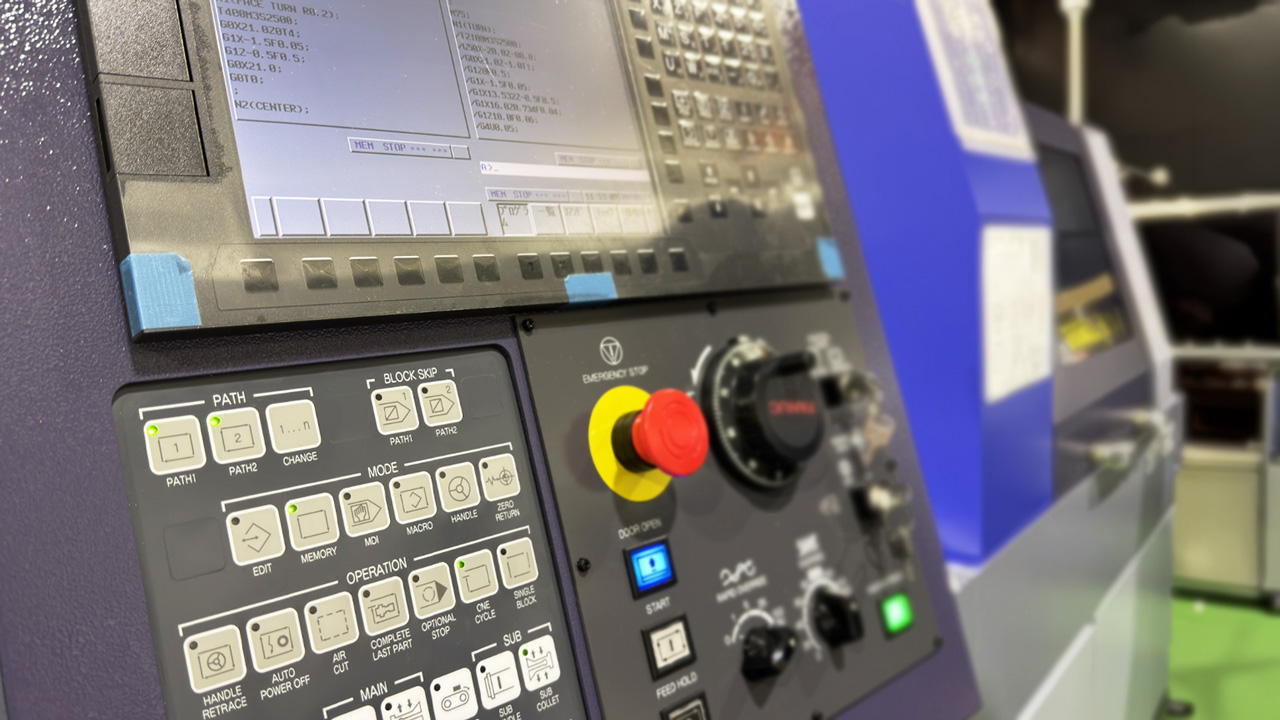
Because the names sound so similar, "CNC automatic lathe" and "NC lathe" are easy to confuse — but there is a clear difference between them.
The big difference is the scope of automation.
An NC lathe is a machine whose machining motions are numerically controlled. A CNC automatic lathe, by contrast, is designed to run continuously from bar-stock feeding through machining, cut-off, and part ejection.
This article sorts out the terminology and explains when to use which.
In This Article
First, the Terms: "NC" and "CNC"
NC (Numerical Control) means controlling a machine with numbers.
It refers to a system that directs the movements of the tools and spindle through numerical values and programs. Instead of hand-cranked wheels, the machine cuts automatically according to a program. That is the essence of NC.
CNC (Computerized Numerical Control) means computer-based numerical control.
It embeds a computer into NC, enabling more sophisticated and flexible control. Virtually all numerically controlled machine tools sold today are CNC machines.
In other words, "NC" and "CNC" reflect different generations of control technology, and today the two terms are often used without strict distinction.
What matters is when the words "automatic lathe" enter the picture.
The Real Difference: Is It an Automatic Lathe?
The big difference between a "CNC automatic lathe" and an "NC lathe (CNC lathe)" is whether the machine is an automatic lathe.
NC Lathes (General-Purpose CNC Lathes)
A typical NC lathe grips and machines workpieces one at a time in a chuck.
Each time machining finishes, the operator removes the workpiece and mounts the next blank.
Because each piece is machined reliably one at a time, these machines suit high-mix, low-volume production and relatively larger workpieces.
CNC Automatic Lathes
A CNC automatic lathe feeds long bar stock automatically with a bar feeder (material-feeding device) and machines parts continuously.
Each time a part is completed from the bar, the material advances by the amount consumed, and the next part is machined right away.
Because machining continues without anyone changing material, these machines excel at volume production through unattended operation at night and on weekends, not just during weekday shifts.
In addition, Swiss-type CNC automatic lathes are equipped with a guide bushing that supports the material right next to the cutting edge, so even long, slender workpieces can be machined with high precision while deflection is suppressed.
Guidelines for Choosing Between Them
Which one to choose comes down to the shape of the parts you want to make and the production volume.
If you want to make small round parts, in large volumes, with as little operator involvement as possible, a CNC automatic lathe is the right fit.
If, on the other hand, you want to machine relatively larger workpieces, reliably one at a time, across many product types, a general-purpose NC lathe — that is, a CNC lathe — is the better choice.
It is not a question of which is superior; they simply have different strengths.
Identifying which type your main parts are closer to is the starting point for machine selection.
The Differences at a Glance
Here is a summary table of the points covered so far.
The terms are easy to confuse, but the key is not the generation of control — it is whether the machine is an automatic lathe.
| Comparison | NC lathe (general-purpose CNC lathe) | CNC automatic lathe |
|---|---|---|
| Material feeding | Gripped one piece at a time in a chuck | Bar stock fed automatically by a bar feeder |
| Machining style | Reliably, one piece at a time | Continuous volume production |
| Unattended operation | Limited | A strength (nights and weekends too) |
| Typical workpieces | Relatively larger; high-mix, low-volume | Small and round; volume production |
| Guide bushing | Generally none | Fitted on Swiss-type machines |
Why the Terms Cause Confusion
These two get mixed up because "NC," "CNC," and "automatic lathe" each describe a different aspect of the machine.
NC/CNC describes the control method, while "automatic lathe" describes the machine's structure and automation mechanism.
They are really separate dimensions, but because the names look alike, it is easy to compare them along the same axis.
To sum up: since CNC control is now used across virtually all machine tools, "CNC or not" is rarely a useful primary criterion for machine selection.
What really deserves attention is whether the machine has an automatic-lathe structure — that is, whether it can feed bar stock automatically and machine continuously.
Reading catalogs from this perspective also makes it much easier to grasp a machine's character.
Frequently Asked Questions (FAQ)
Q. Are NC lathes and CNC lathes different machines?
A. In practice today, the terms are mostly used interchangeably. A CNC is an NC with a built-in computer, and most modern numerically controlled lathes are CNC machines. It is easiest to think of it as a generational difference in control technology.
Q. Which is better for volume production, a CNC automatic lathe or a general-purpose CNC lathe?
A. For volume production of small parts, a CNC automatic lathe is the better fit. Because it feeds bar stock automatically and machines continuously, it suits high-volume production of small parts and unattended operation. A general-purpose CNC lathe, by contrast, grips and machines workpieces one at a time, making it better suited to high-mix, low-volume production and relatively larger workpieces.
Q. How do I decide which one fits my shop?
A. If you want to machine small round parts in large volumes with as little operator involvement as possible, start with a CNC automatic lathe; if you want to machine relatively larger parts reliably across many product types, start with a general-purpose CNC lathe. Thinking in terms of the shape and production volume of your main parts makes the decision easier.
Summary
"NC" and "CNC" reflect different generations of control technology and are used almost synonymously today. What matters is whether the machine is an automatic lathe.
A CNC automatic lathe feeds bar stock automatically and machines small parts continuously. A general-purpose NC lathe — that is, a CNC lathe — grips and machines workpieces one at a time.
For a deeper look at the structure itself, see Basic Structure of a CNC Automatic Lathe.