
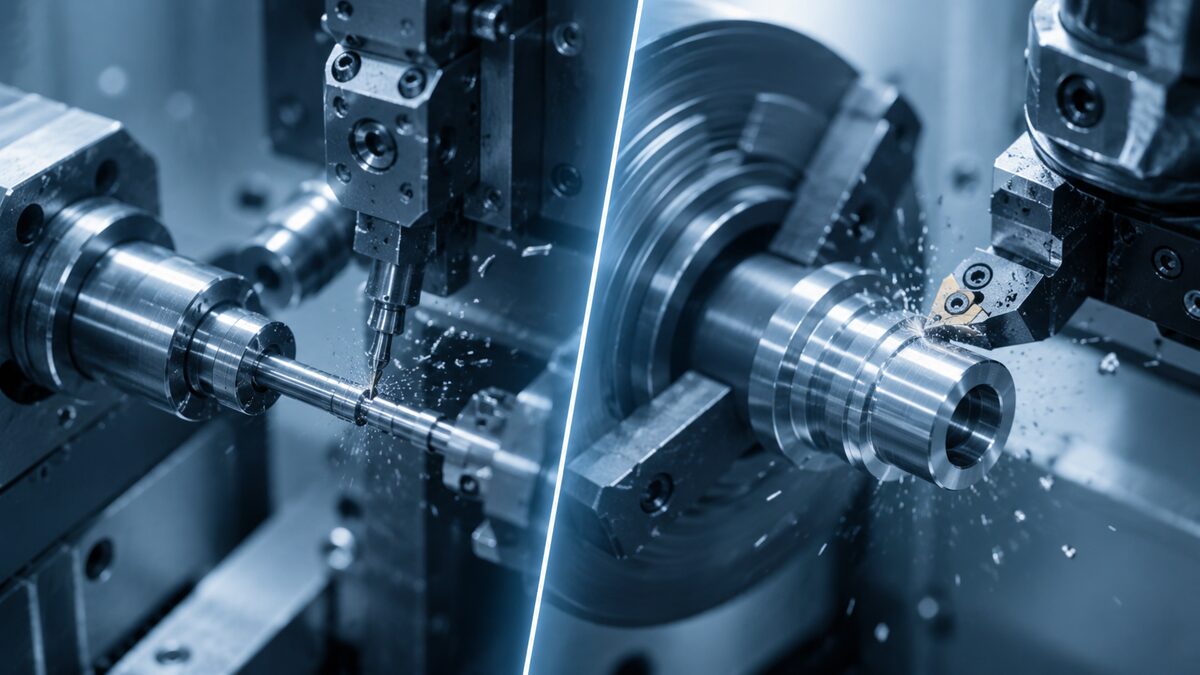
A turning center is a multitasking machine based on a lathe that can also perform milling and drilling with rotary tools such as drills and end mills — all in one machine.
Its defining feature is the ability to perform turning (rotating the workpiece against the tool) and milling/drilling (rotating the tool against the workpiece) in one continuous sequence, with a single setup.
In This Article
A Lathe Plus a Machining Center in One
Traditionally, shops often split the work between separate machines: round features were turned on a lathe, while flat surfaces and cross holes were machined on a machining center.
That approach means removing the workpiece from the lathe, re-mounting it on the machining center, and locating it all over again. This movement between machines and repeated setup has long been a drag on both productivity and machining accuracy.
A turning center reduces these problems by consolidating turning and milling into a single machine.
In addition to the turning spindle, it has a milling function that drives rotary tools, so it can drill cross holes or machine flats and grooves in the same flow right after turning the outside diameter.
The Benefits of Process Integration
The biggest payoff of a turning center is process integration.
By completing multiple operations in a single mounting — one-chucking machining — you can expect benefits like these.
Accuracy becomes more stable.
Because the positioning errors introduced each time a workpiece is re-mounted are suppressed, positional relationships between machined surfaces — coaxiality and perpendicularity, for example — are easier to maintain.
Setup effort goes down.
With less need to move parts between machines and set up again, the number of setups is reduced. The result is shorter lead times.
Work in process and material handling shrink.
Fewer workpieces sit waiting between processes, easing the burden of in-plant transport and storage space.
How It Relates to CNC Automatic Lathes
A natural question at this point: how does this differ from a CNC automatic lathe?
In fact, many high-end modern CNC automatic lathes have the same multitasking character as a turning center.
Equipped with rotary tools and capable of simultaneous machining on the main and back spindles as well as milling, they can machine complex small parts from bar stock and eject them as finished parts in one uninterrupted flow.
As a rough distinction, it helps to think of it this way: a turning center performs multitasking machining on relatively larger workpieces held in a chuck, while a CNC automatic lathe performs multitasking machining on small parts in volume production, fed bar stock by a bar feeder.
Both share the same underlying idea: process integration makes it easier to raise accuracy and productivity.
Key Points When Considering Adoption
Turning centers are highly productive machines, but adopting one requires a substantial investment.
When evaluating one, it is important to assess whether it will actually pay off for your operation, from viewpoints such as the following.
First, do you have parts that are currently machined in sequence on multiple machines?
If workpieces are being moved between a lathe and a machining center, consolidating those operations onto a turning center may cut setup and positioning work.
Second, is positional accuracy — coaxiality or perpendicularity, for example — critical to the part's quality?
Because errors from re-mounting the workpiece are suppressed, a turning center tends to deliver clear benefits for such parts.
Third, how frequent are changeovers, and how much work in process do you carry?
Whether process integration can reduce the number of setups and inter-process inventory is a key point when thinking about return on investment.
On the other hand, if you produce only simple round parts, or only simple prismatic parts, in large volumes, a dedicated machine may still be the better choice.
The deciding factor is whether you have parts you want to finish completely on one machine across multiple operations.
Frequently Asked Questions (FAQ)
Q. What is the difference between a turning center and a machining center?
A. They are based on different machines. A turning center is based on a lathe — a machine that rotates the workpiece against a cutting tool — with milling capability added. A machining center, by contrast, is a machine tool centered on milling, where the rotating cutter does the cutting. For mostly round parts, a turning center is the natural starting point; for prismatic or complex-shaped parts, a machining center is.
Q. What is one-chucking machining?
A. It means completing multiple operations while the workpiece remains gripped (chucked) once, without re-fixturing. Because it avoids the errors introduced each time a workpiece is re-mounted, it makes it easier to maintain positional accuracy between machined surfaces.
Q. How do I decide between a CNC automatic lathe and a turning center?
A. A useful rule of thumb: a CNC automatic lathe performs multitasking machining on small parts in volume production from bar stock, while a turning center performs multitasking machining on relatively larger workpieces held in a chuck.
Summary
A turning center is a multitasking machine that integrates turning and milling into one machine and finishes complex parts in a single chucking.
Process integration brings benefits in accuracy, lead time, and material-handling load alike.
The same multitasking philosophy carries over to CNC automatic lathes, which are optimized for small-part volume production.
For where these machines fit in the overall landscape, see Main Types of Machine Tools; for the machining principles themselves, see Main Machining Methods.