
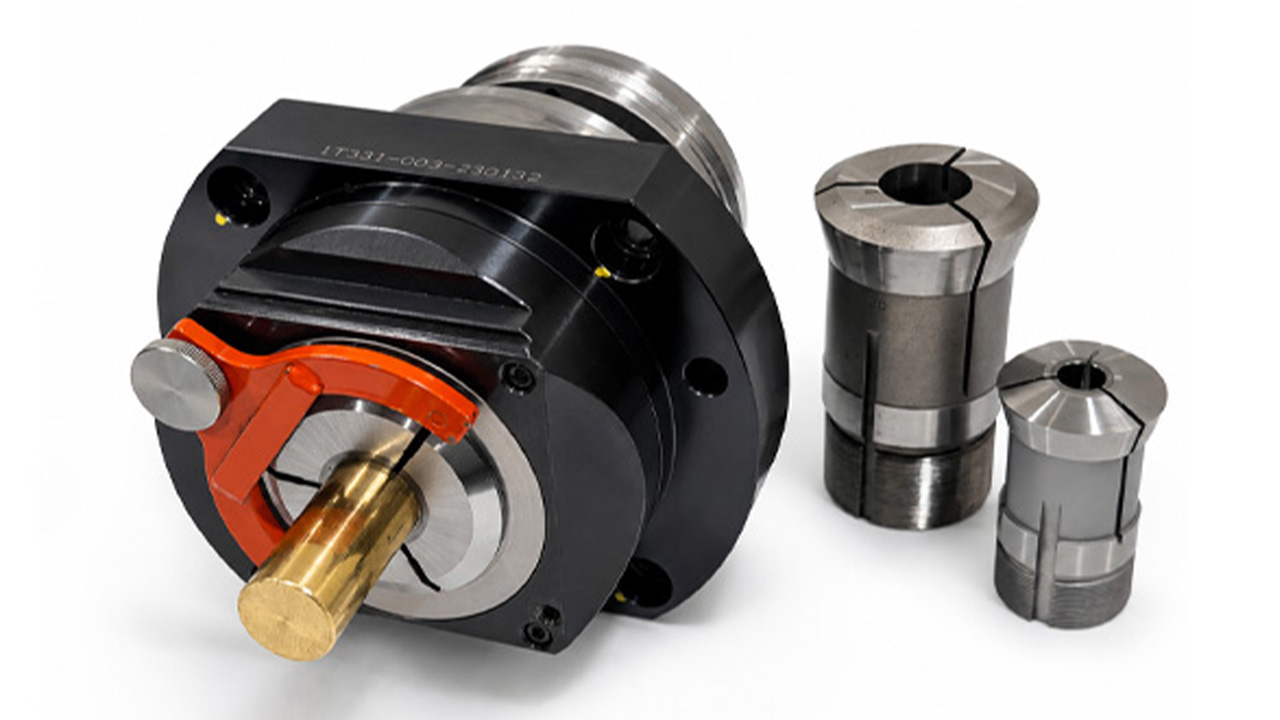
The guide bushing is the component that truly holds the "key" to the high precision of Swiss-type CNC automatic lathes.
Unassuming as it is, its presence or absence dramatically changes the accuracy and shapes of the parts a machine can produce.
This page explains, as plainly as possible, what the guide bushing actually does.
In This Article
What Is a Guide Bushing?
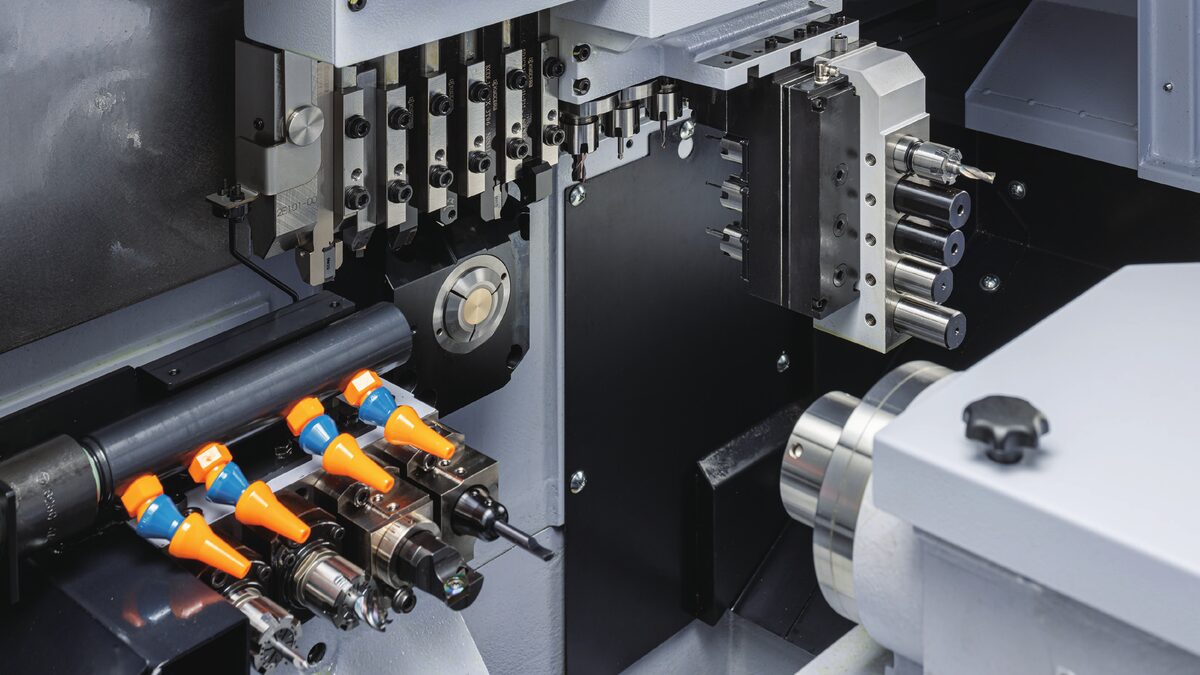
The guide bushing is a bearing (bush) that supports the bar stock during machining, right next to where the cutting tool engages.
The bar passes through the bore of the guide bushing and is machined while supported just in front of the cutting edge.
To picture it, imagine whittling the tip of a long stick: because the stick would flex, you press a finger firmly right next to the spot you are cutting.
The closer the support is to the cutting point, the steadier the stick and the cleaner the cut.
The guide bushing plays exactly this role of "supporting the material right next to where it is cut."
Why the Guide Bushing Works — the Deflection Problem
When turning long, slender material on a lathe, the greatest enemy is deflection.
When the distance from the support point (chuck or bushing) to the cutting edge is long, cutting forces bow the material.
Machining a deflected workpiece throws off dimensions, roughens the surface, and ruins roundness.
The smaller the diameter and the longer the part, the more serious this deflection becomes.
The guide bushing suppresses this deflection at its root by supporting the material right next to the cutting edge.
Because the distance from support to cutting edge (the overhang) stays short, even long, slender workpieces can be machined as steadily as if they were thick stock.
This is the biggest reason Swiss-type machines are known for excelling at slender, high-precision work.
For how the Swiss-type works as a whole, see What Is a Swiss-Type CNC Automatic Lathe?.
Guide-Bushing and Non-Guide-Bushing Configurations
The guide bushing brings advantages, but also characteristics you should know about.
That is why two configurations are used, depending on the application.
Guide-bushing configuration
The standard configuration, using the guide bushing.
It is ideal for machining long, slender parts to high precision.
On the other hand, the bar cannot be used up to its end, so a longer remnant (end material) is left for the portion that must pass through the bushing, and the process is sensitive to variation in bar diameter, requiring straight material with stable diameter accuracy.
Non-guide-bushing configuration
A configuration that machines with the guide bushing removed.
Remnants are shorter, so material yield is better, and tolerance for bar-diameter variation is comparatively relaxed.
It suits parts whose diameter is large relative to their length (stubby parts).
For long, slender parts, however, it cannot suppress deflection as effectively as the guide-bushing configuration.
In recent years, removable / convertible machines that can switch between the two on a single unit have become more common, letting you use or remove the guide bushing to suit the part being machined.
Star Micronics — strong at switching between GB and NGB configurations
Star Micronics, holding a world-leading share in Swiss-type machines (per the company's press releases), supports switching between guide-bushing and non-guide-bushing configurations on many current models.
One machine combines high-precision machining of long parts with reduced end material on short parts, supporting high-mix production floors.
The Concept of "Overhang"
The keyword for a deeper understanding of the guide bushing's effect is "overhang."
This is the length of material projecting from the support point (guide bushing or chuck) to the cutting edge.
In turning, the longer this overhang, the more easily the material deflects and the worse the accuracy becomes.
Push on the tip of a thin rod supported far away and it bends a lot; support it close by and it barely bends — intuitively obvious.
By supporting the material right next to the cutting edge, the guide bushing keeps the overhang consistently short and holds deflection in check.
Keeping the overhang short is the very essence of how the guide bushing delivers high precision.
Choosing the Right Configuration
Whether to choose the guide-bushing or non-guide-bushing configuration comes down to the shape of the parts you make.
Here are the basic guidelines.
Cases suited to the guide-bushing configuration: long, slender parts with high length-to-diameter ratios, parts requiring high straightness and roundness, and micro-precision parts for medical or semiconductor applications.
Cases suited to the non-guide-bushing configuration: short, stubby parts, cases where you want to cut material costs by reducing remnants (end material), and cases where you need tolerance for bar-diameter variation.
In recent years, removable / convertible machines that can switch between both on one unit have become more common, allowing flexible use to match the part.
Frequently Asked Questions (FAQ)
Q. Is the guide bushing a consumable part?
A. Because it contacts and supports the material, it wears with use.
Maintaining accuracy requires proper management and periodic replacement.
Q. Why does a guide-bushing configuration leave a longer remnant bar?
A. Because machining is done with the material passed through the guide bushing, the last portion of the bar cannot pass through the bushing and cannot be machined.
That portion remains as remnant (end) material.
Q. Does accuracy drop with a non-guide-bushing configuration?
A. For long, slender parts, it cannot suppress deflection as effectively as a guide-bushing configuration.
For short parts, however, the difference tends to be small, and benefits such as reduced remnant material can outweigh it.
Summary
The guide bushing is the heart of the Swiss-type CNC automatic lathe: by supporting the bar right next to the cutting edge, it keeps the overhang short, suppresses deflection, and makes high-precision machining of long, slender parts possible.
Because it also brings constraints such as remnant material and bar-diameter requirements, the guide-bushing and non-guide-bushing configurations are used according to the application.
For the characteristics of the Swiss-type as a whole, also see What Is a Swiss-Type CNC Automatic Lathe?.