
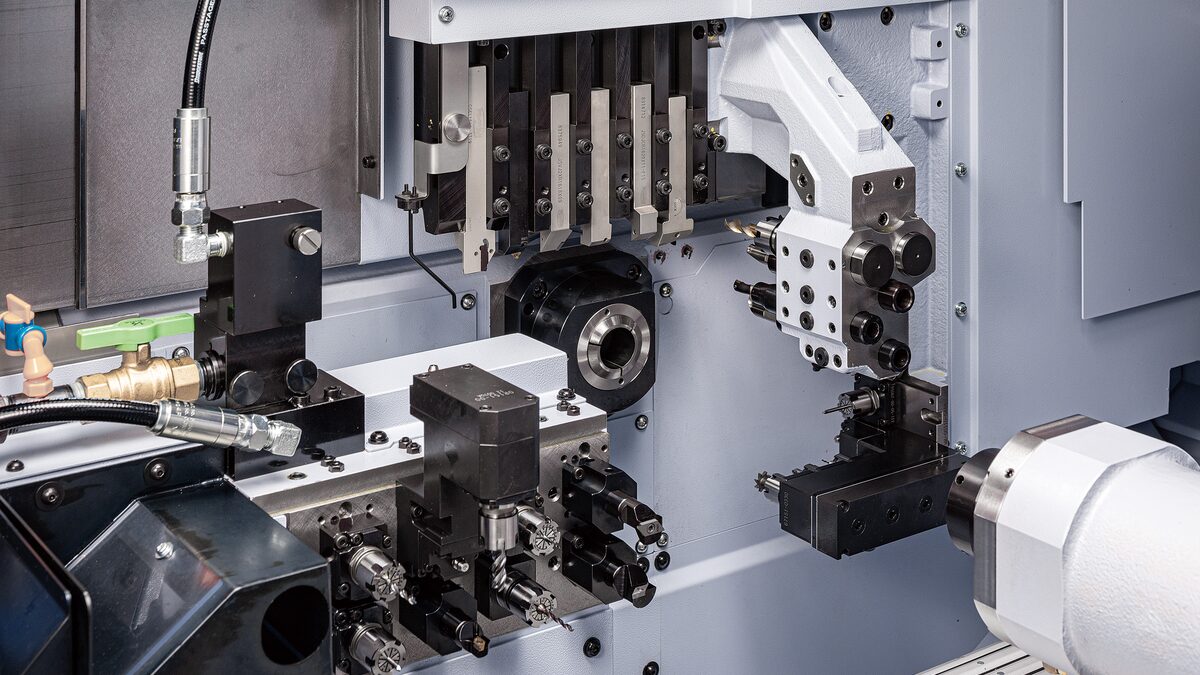
When choosing a CNC automatic lathe, the tool post design matters as much as the Swiss-type vs. fixed-headstock classification.
The tool post is the part that holds the tools that cut the workpiece.
The design directly affects machining speed, how many tools can be mounted, and what work the machine does best.
Tool posts fall into two main types: gang and turret.
In This Article
Gang Type (Gang Tooling)
The gang type mounts multiple tools fixed in a single row, like the teeth of a comb.
It is also known as "gang tooling."
Its biggest advantage is fast tool switching.
Because the tools sit in a single row, sliding the tool post sideways is all it takes to bring the next tool into position, keeping tool-change time (non-cutting time) to a minimum.
With shorter per-part machining times, it excels at high-speed mass production of simply shaped parts.
On the other hand, there is a physical limit to how many tools can be lined up, so it may not suit very complex jobs that require many tools.
Turret Type
The turret type arranges tools radially (a turret, shaped like a rotating gun turret) and indexes them by rotation.
The turret rotates to bring the desired tool into position for machining.
Its advantage is large tool capacity.
With tools mounted on each face of the turret, it handles complex parts with many operations more easily.
It suits high-mix or complex-shape machining, and parts that require a variety of operations.
However, because the turret must rotate for every tool change, tool changes tend to take longer than on a gang type.
Which One to Choose
The rule of thumb is simple.
Choose the gang type for speed-focused, simple volume production, and the turret type for complex machining that needs many tools — that is the basic approach.
In practice, some models combine the two.
For example, a machine may have a gang tool post plus a turret for back machining, configured flexibly to match the work.
Deciding whether your parts call for "simple shapes, fast and in quantity" or "complex shapes, built up carefully" is the starting point of tool post selection.
For details on each, see the dedicated pages on turret-type lathes and gang-type lathes.
Gang-Type Lathes
How the gang tool post lines tools up like a comb for near-zero indexing time, enabling fast, high-precision volume production — structure and benefits.
Learn more →Turret-Type Lathes
The structure and features of the turret tool post, which carries many tools and handles complex, multi-operation machining.
Learn more →Gang Type vs. Turret Type: Comparison Table
Here is a summary of the differences between the two tool post designs.
The deciding factor is whether you prioritize cycle time (machining time per part) or tool capacity and flexibility.
| Comparison Item | Gang Type (Gang Tooling) | Turret Type |
|---|---|---|
| Tool arrangement | Fixed in a single row | Radial, indexed by rotation |
| Tool-change speed | Fast (slide only) | Somewhat slower (rotation) |
| Tool capacity | Limited | Large |
| Best-suited work | High-speed volume production of simple shapes | Complex shapes, high-mix production |
| Good match with | Swiss-type (slender-part volume production) | High-mix, complex machining |
Real Machines Often Combine Both
While this page has contrasted the two, in real machines it is quite common to find models that combine a gang tool post with a turret.
For example, front machining runs fast on the gang tool post, while back machining and complex additional operations are handled by the turret.
This combines the speed of the gang type with the tool capacity and flexibility of the turret type in a single machine.
When selecting a machine, check whether the tool post is a single design or a combination, and whether the tool capacity is sufficient for the complexity of your parts.
Frequently Asked Questions (FAQ)
Q. Which is better for volume production, gang type or turret type?
A. For producing simple shapes fast and in large volumes, the gang type has the edge.
Tool changes are quick, shortening per-part machining time.
For complex shapes or high-mix volume production, the turret type is better suited.
Q. What is gang tooling?
A. It is another name for the gang (comb-style) tool post.
The name comes from arranging the tools in a single row — a "gang" — like the teeth of a comb.
Q. Which should we choose if our parts are complex?
A. For complex shapes requiring many tools, the turret type with its larger tool capacity is the standard choice.
That said, machines that combine a gang tool post with a turret can deliver both.
Summary
Tool posts fall into two main types: the gang type, which lines tools up in a row for fast switching, and the turret type, which carries many tools arranged radially.
Keep in mind "speed for the gang type, tool capacity for the turret type," and the right configuration for your machining will come into focus.
Many real machines combine the two, so consider tool post design together with the Swiss-type vs. fixed-headstock classification.