
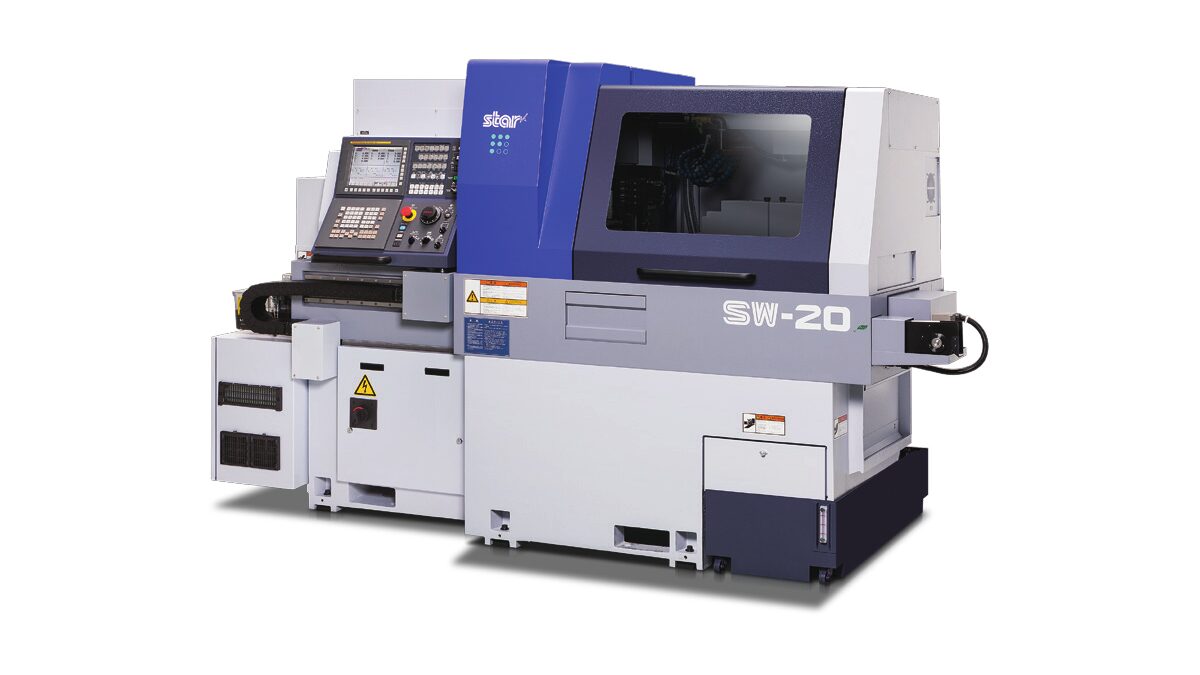
The Swiss-type CNC automatic lathe outperforms other machine types when it comes to volume production of long, slender parts at high precision.
It is widely used in fields that demand parts that are "slender, precise, and produced in volume" — medical components, connectors, and parts for semiconductor production equipment, for example.
Let's look at the structure to see why the Swiss-type is so strong on precision.
In This Article
Roots in the Watch Industry
The Swiss-type, as the name suggests, was born and refined in the Swiss watch industry.
Watch movements contain many shafts and screws as thin as a human hair.
The need to mass-produce such minute parts to high precision drove the development of automatic lathes with this distinctive structure.
It is also called the "sliding-headstock" or "traveling-headstock" type.
The Sources of Precision: Guide Bushing + Sliding Headstock
The secret to the Swiss-type's precision lies in two structural innovations.
(1) The guide bushing: support right next to the cutting edge
A Swiss-type lathe is equipped with a component called the guide bushing.
It acts as a bearing that supports the material immediately next to where the tool cuts.
In turning, the greater the distance between the point where the material is supported and the cutting edge, the more the cutting forces deflect the material and degrade accuracy.
The longer and thinner the bar, the more serious this deflection becomes.
On a Swiss-type machine, the guide bushing supports the material right next to the cutting edge, keeping deflection to a minimum.
This is the single biggest reason for its high precision.
(2) The main spindle travels back and forth
On a Swiss-type lathe, the main spindle gripping the material itself moves back and forth.
The material is fed out through the guide bushing, and it is the material side that moves against the stationary tool as it is cut.
This arrangement keeps the guide bushing's support constantly close to the cutting edge while the material is machined continuously from back to front.
A long, slender shaft can be cut with uniform precision from one end to the other.
What the Swiss-Type Does Best
Given this structure, the Swiss-type excels at the following kinds of machining.
Long, slender parts: even thin shafts a few millimeters in diameter can be machined precisely without deflection.
The more slender the part relative to its length, the more the Swiss-type shows its true value.
High-precision, high-quality finishes: it suits parts that demand straightness, roundness, and a smooth surface finish.
Volume production of precision small parts: once the setup is established, it can mass-produce unattended while holding high precision.
In concrete terms, it shines in volume production of small parts that demand micron-level precision: bone screws and implants for medical devices, endoscope components, connectors and terminals, micro parts for semiconductor production equipment, and automotive sensor parts.
Star Micronics Swiss-type lathes: high-precision volume production of small-diameter, long parts
Star Micronics, which holds a world-leading share in Swiss-type CNC automatic lathes (per company press releases), combines high precision and high efficiency through rigid machine design and proprietary controls.
Its broad lineup includes models that convert between guide-bushing and non-guide-bushing configurations, supporting shops that mass-produce small-diameter, long parts.
How It Differs from the Fixed-Headstock Type
In contrast to the Swiss-type and its deflection-suppressing structure, the fixed-headstock type, which does not use a guide bushing, has the advantage for larger-diameter, shorter parts and for reducing remnant stock.
"Swiss-type for slender, high-precision parts" is the basic guideline for machine selection.
Cutting-Edge Fields Supported by the Swiss-Type
The Swiss-type's strength in slender, high-precision work is becoming ever more important as products grow smaller and more sophisticated.
Let's look at the specific fields where these machines are used.
In the medical field, they produce extremely high-precision parts that interact with the human body: bone screws for fixing bone, dental implants, and endoscope components.
In semiconductors and electronics: micro connectors and terminals, and precision parts for production equipment.
In telecommunications: 5G-related antenna and filter components.
In automotive: various sensors and precision fuel-system parts.
All share the traits of being "small, precise, and needed in volume" — exactly the territory where the Swiss-type is strongest.
The more advanced a product becomes, the finer and more precise its internal parts become.
The Swiss-type CNC automatic lathe is the machine quietly underpinning this trend.
What It Takes to Get the Most from a Swiss-Type
For all its precision, the Swiss-type has some prerequisites for delivering its full performance.
The classic one is "bar diameter accuracy."
Because the guide bushing supports the material precisely, variation in bar diameter can affect machining accuracy or cause trouble.
Swiss-type machining therefore calls for straight bar stock with tight diameter tolerances.
Stable, high-precision volume production also requires a certain level of skill in setup and adjustment.
Used with these prerequisites understood, the Swiss-type opens up a level of precision that other machine types cannot reach.
Frequently Asked Questions (FAQ)
Q. Why can a Swiss-type lathe machine slender parts to such high precision?
A. Because the guide bushing supports the material right next to the cutting edge, suppressing deflection during machining.
The closer the support is to the point of cutting, the less even a long, slender workpiece wanders during the cut.
Q. In which industries are Swiss-type lathes used?
A. They are widely used in cutting-edge fields that need large volumes of small, precise parts, such as medical, semiconductor and electronics, telecommunications (5G), and automotive.
Q. Does the Swiss-type have drawbacks?
A. Its remnant (bar-end) stock is longer, and it is demanding about bar diameter accuracy.
For larger-diameter, shorter parts, or when reducing remnant stock matters most, a fixed-headstock machine may be the better fit.
Summary
The Swiss-type CNC automatic lathe supports the material near the cutting edge with a guide bushing and machines with a traveling spindle, enabling high-precision volume production of long, slender parts without deflection.
Honed in the watch industry, this structure now supports precision parts manufacturing in cutting-edge fields such as medical, semiconductor, and connectors.
See also The Role of the Guide Bushing — the heart of this machine type.