
Cutting — making parts by removing material on a machine tool — follows a few basic patterns.
All the typical cutting processes share one thing: they remove unwanted material from the stock. What differs is what rotates, and how the cutting tool is applied.
This article organizes the main machining methods and looks at the role the CNC automatic lathe plays among them.
In This Article
Turning — Rotating the Workpiece
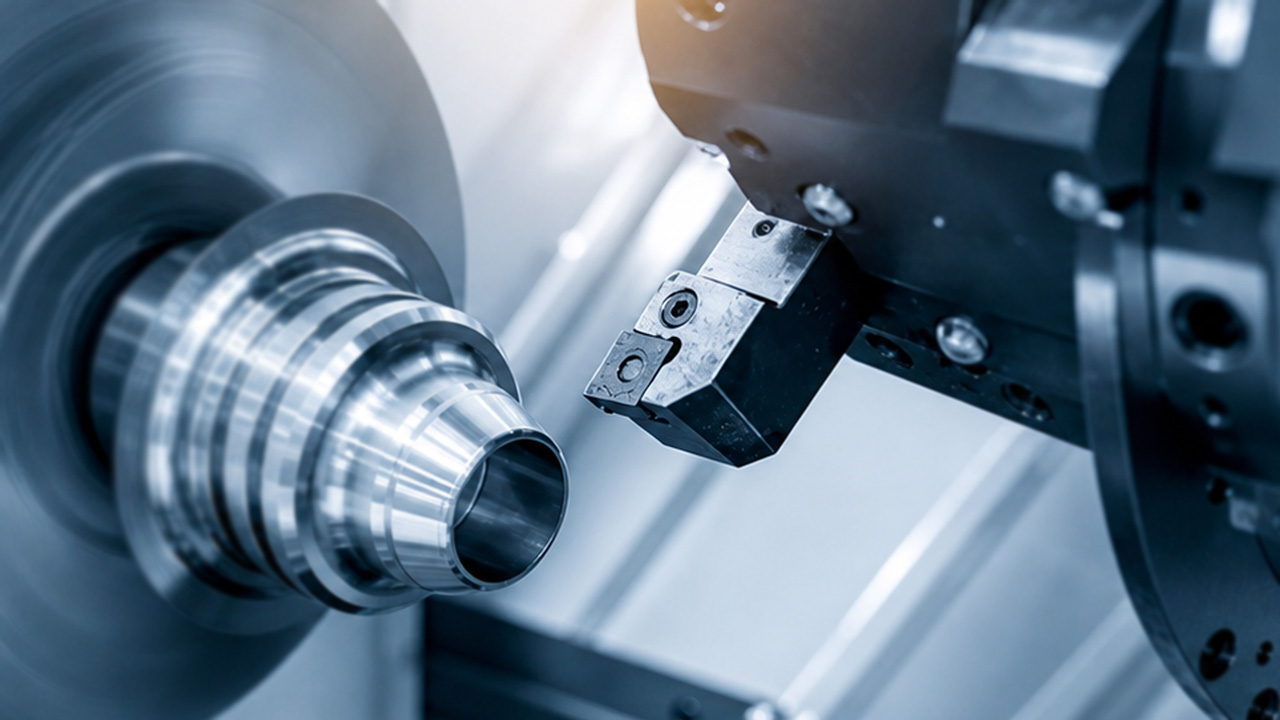
Turning rotates the workpiece and cuts it by bringing a cutting tool against it.
Because the tool engages a rotating workpiece, turning excels at rotationally symmetric shapes such as cylinders, cones, and threads.
Typical operations include OD turning (cutting the outer circumference), facing (flattening the end face), boring (opening up the inside), threading (cutting screw threads), and grooving.
Turning is the core of what lathes and CNC automatic lathes do.
Round, slender parts such as shafts, pins, bushings, and connector components take their shape through turning.
Milling — Rotating the Cutter
Milling is the opposite of turning: the cutting tool — a milling cutter or end mill — rotates and cuts a fixed workpiece.
It excels at non-round features: machining flat surfaces, cutting grooves, creating steps, and profiling complex contours.
Milling is the core of what machining centers do.
Drilling
Drilling makes holes by rotating the drill or the workpiece.
It is one of the most fundamental operations and is performed on both lathes and machining centers.
Related operations include reaming, which precisely finishes the inside surface of a drilled hole, and tapping, which cuts internal threads. These are performed to improve the accuracy and function of the hole.
Grinding — Precision Finishing with an Abrasive Wheel
Grinding is a finishing process in which a high-speed abrasive wheel removes material from the surface a tiny amount at a time, improving dimensional accuracy and surface smoothness — that is, surface roughness.
It is used when a near-mirror finish, difficult to achieve with ordinary cutting tools, or micron-level accuracy is required.
A distinctive strength is its ability to machine hardened materials.
The Machining a CNC Automatic Lathe Handles
A CNC automatic lathe is a machine tool that combines turning as its core process with milling and drilling performed by rotary tools.
It grips bar stock in the main spindle and rotates it, turning the outside diameter, end faces, and threads, while drilling cross holes or machining flats as needed.
In other words, several machining methods are used in succession inside a single CNC automatic lathe.
This lets it machine complex shapes — say, a small threaded shaft part with a cross hole — continuously from bar stock and eject them as finished parts.
This integration of multiple operations is the same idea behind the turning center (multitasking machine).
The Specific Operations Within Turning
Turning, the core process of a CNC automatic lathe, is in practice a combination of many smaller operations.
In the course of finishing a single part, these operations run one after another. Here are the most common ones.
OD turning
Cutting the outer circumference of the rotating stock to the target diameter.
Facing
Cutting the end face of the stock flat and bringing it to length.
Cut-off (parting)
Separating the finished part from the bar stock. This step is essential to the continuous production of an automatic lathe.
Threading
Cutting screw threads on the outside or inside.
Boring
Enlarging the inside diameter of a drilled hole or finishing it precisely.
On an automatic lathe, these operations execute in sequence within a single program, and the bar stock is gradually finished into the shape of the part.
Machining Methods and Surface Roughness
One concept worth knowing when studying machining methods is surface roughness.
Surface roughness is a measure of how smooth a machined surface is, and the required level varies with the part's application.
The typical flow is to machine the part to the required shape by cutting — turning and milling — and then finish by grinding when higher smoothness or accuracy is needed.
In recent years, however, improvements in automatic-lathe accuracy mean that cutting alone increasingly delivers high surface quality.
Which machining method to use, and what level of quality to aim for — this too is an important consideration in machine selection and process design.
Frequently Asked Questions (FAQ)
Q. What is the difference between turning and grinding?
A. Turning removes material with a cutting tool (such as a single-point turning tool). Grinding, by contrast, removes material a tiny amount at a time with an abrasive wheel to achieve high accuracy and a smooth finished surface. Grinding is also used to machine hardened materials.
Q. Are multiple machining methods used on a single part?
A. Yes. Even a single part machined on an automatic lathe goes through several operations in succession, such as OD turning, drilling, threading, and cut-off.
Q. Can a CNC automatic lathe also perform milling?
A. Yes. Models equipped with rotary tools can perform milling operations such as cross-drilling and flat machining in addition to turning, which allows complex small parts to be finished on a single machine.
Summary
Machining methods on machine tools fall into categories such as turning, milling, drilling, and grinding, each with its own strengths in shape and role. The CNC automatic lathe is a machine tool that combines several of these — with turning at the core — to finish small precision parts continuously.
Next, take a look at CNC Automatic Lathes vs. NC Lathes.