
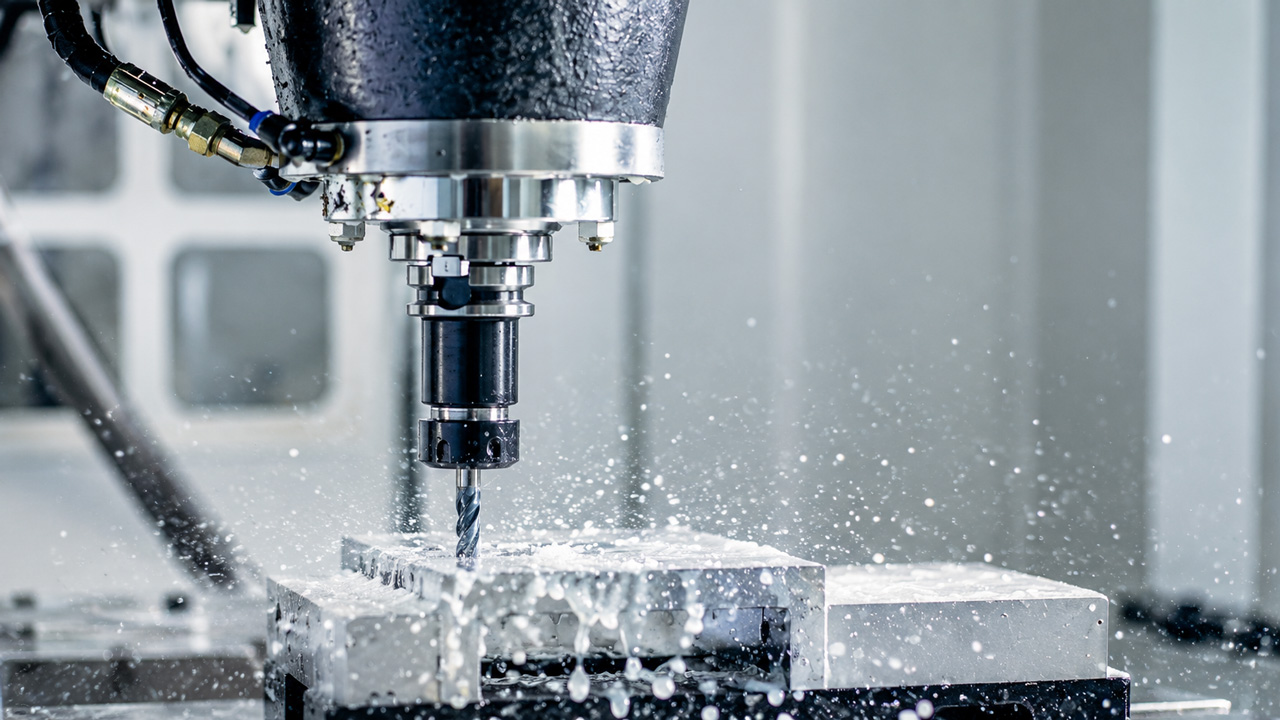
A machining center is a machine tool that performs multiple operations in one unit — milling above all, plus drilling, boring, and tapping.
Because it can change tools automatically as it machines, it reduces setup changes and handles even complex parts efficiently.
It is sometimes abbreviated as "MC."
An easy way to picture it: a milling machine taken to a high level of automation and multifunctionality.
In This Article
The Defining Feature: The ATC
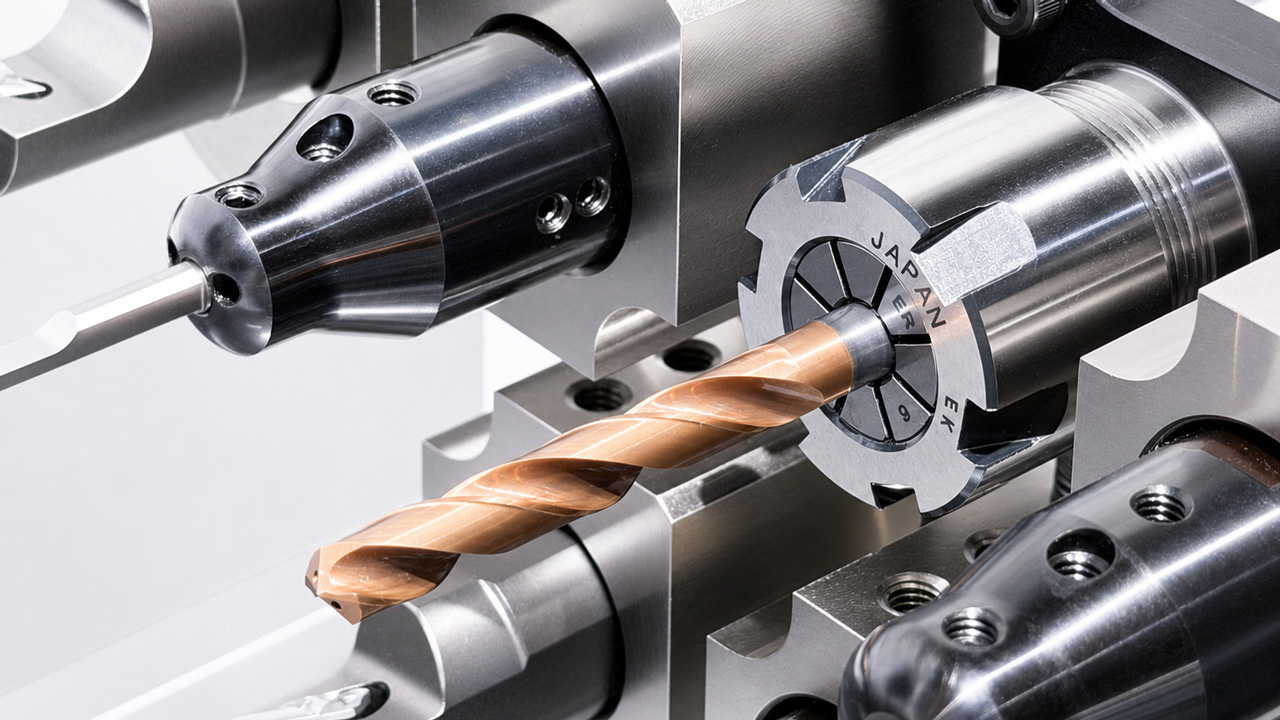
What defines a machining center is the ATC (Automatic Tool Changer).
A machining center has a "magazine" that stores a set of tools, and it swaps tools automatically according to the NC program as the machining requires.
For example, it can face-mill a flat surface, then drill holes, and finally cut threads with a tap — executing the whole sequence continuously without anyone changing tools by hand.
This automatic tool changing is the key point that distinguishes it from an ordinary milling machine.
Classification by Spindle Orientation
Machining centers fall into two main types — vertical and horizontal — according to the orientation of the spindle, the axis that rotates the tool.
A vertical machining center has its spindle oriented vertically.
Because the tool cuts from above, setup and in-process checking are easy, and this type is used across a wide range of applications.
It is common in die and mold work, prototyping, and general parts machining.
A horizontal machining center has its spindle oriented horizontally.
It machines the sides of a workpiece easily, and with a pallet or rotating table it can machine several faces in a single setup.
Chips fall away readily, giving excellent chip evacuation, so it also suits volume production.
There are also 5-axis machining centers, which tilt the tool or table to machine from multiple directions.
This is a somewhat different classification from vertical/horizontal, but because these machines can finish complex shapes in a single setup, they excel at work such as aerospace parts and precision dies and molds.
How Its Role Differs from Lathes and Automatic Lathes
Machining centers and lathes differ fundamentally in what rotates.
A machining center rotates the spindle holding the tool and cuts by bringing it against the workpiece, whereas a lathe rotates the workpiece and cuts by bringing a tool against it.
Their strengths are correspondingly distinct.
A machining center excels at producing parts with flat surfaces, grooves, complex contours, and holes in multiple directions from block-shaped stock.
A CNC automatic lathe, on the other hand, excels at mass-producing small, round, slender parts such as shafts and screws from bar stock.
On the shop floor, the two are less competitors than complements.
The usual division is lathe-type machines for round parts and machining centers for prismatic or complex shapes.
Merging the strengths of both is the turning center (multitasking machine), which performs turning and rotating-tool machining in a single unit.
Typical Parts Made on Machining Centers
Machining centers excel at cutting complex shapes — combinations of flat surfaces, holes, grooves, and steps — out of block-shaped stock.
Typical examples include molds for forming plastic products, brackets and base plates for mounting components in equipment, pump and valve housings, and structural parts for the aerospace sector.
All of these are parts with flat surfaces, steps, holes in several directions, and complex contours — shapes that are hard to machine on lathe-type machines, which favor round work.
Put the other way around, in shops where such prismatic and complex-shaped parts dominate, the machining center plays the central role.
Understanding the "Number of Axes"
When researching machining centers, you will come across terms like "3-axis" and "5-axis."
These indicate the number of directions in which the tool or workpiece can move simultaneously — in other words, the number of axes.
The baseline is three axes of movement — front-back, left-right, and up-down — that is, the X, Y, and Z axes.
Add two rotary or tilting axes to these, and you have what is generally called a 5-axis machining center.
Because a 5-axis machine can cut from multiple directions while reorienting the workpiece or tool, it can finish complex shapes in a single setup. Fewer setup changes mean setup errors are easier to control, and lead times shrink as well. It also handles parts with many curved surfaces, such as turbine blades, with relative ease.
Some CNC automatic lathes likewise feature a B-axis for angled-hole drilling and machining from multiple directions. The underlying idea is the same: adding directions of machine movement to machine complex shapes efficiently.
Frequently Asked Questions (FAQ)
Q. How does a machining center differ from a milling machine?
A. The basic machining principle — rotating a cutting tool to remove material — is the same. The big difference is that a machining center is equipped with an ATC (automatic tool changer). It can run multiple processes such as drilling, tapping, and face milling in succession while automatically swapping between tools.
Q. Vertical or horizontal — which should a beginner picture first?
A. Start by picturing the widely used vertical machining center. On a vertical machine the spindle points downward and the tool cuts from above. On a horizontal machine the spindle is oriented horizontally, making it strong in volume production and multi-face machining.
Q. Do machining centers and CNC automatic lathes compete with each other?
A. Rather than competing, they are machine tools with different strengths. The usual division of labor is machining centers for prismatic and complex-shaped parts, and CNC automatic lathes for volume production of round and small parts.
Summary
The machining center is a machine tool whose strength is ATC-based automatic tool changing, letting one machine handle multi-face, multi-process machining centered on milling. It excels at prismatic and complex shapes such as dies, molds, and housings, and it divides the work with the CNC automatic lathe, which excels at volume production of round parts.
Next, see What Is a Turning Center? for a look at the machine that integrates turning and milling.