
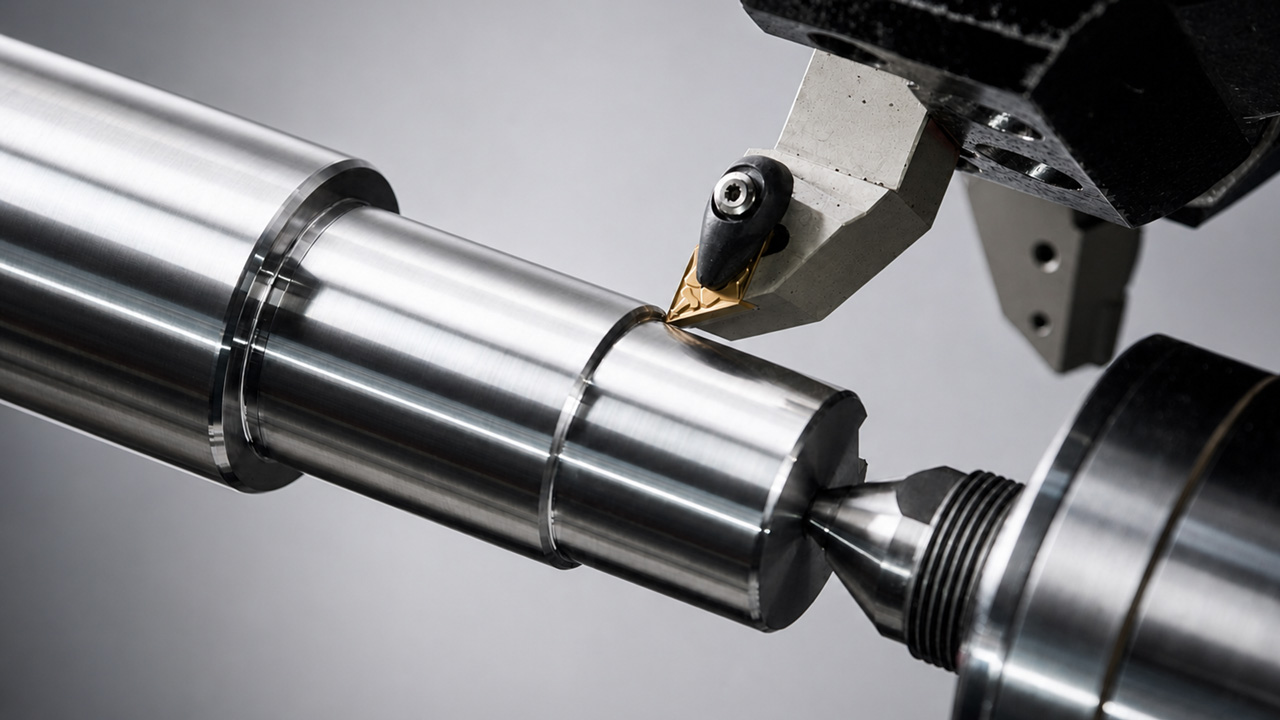
Oscillation cutting is a technique in which the tool or spindle is vibrated slightly during machining so that chips break into small pieces.
It is also known as "low-frequency vibration cutting."
When chips form long, continuous strings, they can wrap around the tool or workpiece and cause machining defects or machine stoppages.
Oscillation cutting reduces these chip problems and is a key technology for keeping unattended operation of CNC automatic lathes stable.
In This Article
Why Chips Become a Problem
Cutting metal always produces chips (swarf).
Depending on the material and cutting conditions, the chips sometimes fail to break and come off as long, continuous strings.
This tends to happen with ductile materials such as aluminum, copper, stainless steel, and plastics.
Long, continuous chips can wrap around the tool or workpiece, tangle at the cutting area and scratch the part, or clog the machine and shut down automatic operation.
Stable chip control is especially important on CNC automatic lathes, which often run unattended at night and on weekends.
If tangled chips stop the machine while no one is around, production is lost for that entire period.
How well you control chips is therefore critical to stable unattended operation.
How Oscillation Cutting Works
Oscillation cutting suppresses this chip problem by means of vibration.
During machining, a small, deliberate vibration — an oscillation — is applied in the feed direction, periodically creating moments when the tool briefly separates from the workpiece.
Because the tool momentarily leaves the workpiece, the chip breaks more easily and is divided into small pieces before it can grow long.
Picture it as cutting not by feeding the tool straight in at a constant rate, but by rapidly repeating an "advance, then back off slightly" motion.
This motion turns the chips into small fragments that are easily evacuated from the machine.
Benefits of Oscillation Cutting
The advantages of oscillation cutting go beyond stabilizing unattended operation.
By breaking chips into small pieces and making them easier to evacuate, it offers benefits such as the following.
- More consistent machining quality
Chips are less likely to tangle around the workpiece or tool, making it easier to prevent scratches on the machined surface. - Better suited to long continuous and unattended operation
Improved chip evacuation helps reduce jams and tangles inside the machine. - More stable tool life
Because chips cling to the tool less, loads on the tool and sudden trouble are easier to keep in check. - Easier handling of materials with difficult chip control
Even ductile materials prone to long chips can be brought into stable volume production.
A Natural Fit for CNC Automatic Lathes
Oscillation cutting pairs especially well with CNC automatic lathes.
Because these machines often run unattended for long stretches, chips that resist tangling and evacuate reliably are extremely valuable.
Machine tool manufacturers each offer this low-frequency vibration cutting under their own names and control technologies, using it to support volume production of difficult-to-machine materials and unattended operation.
Materials and Situations Where It Helps Most
Oscillation cutting delivers the greatest benefit when machining materials whose chips tend to form long strings.
Typical examples include stainless steel, aluminum, copper, and plastics.
These materials are ductile: in conventional cutting, their chips stretch out without breaking and readily wrap around the tool or workpiece.
In terms of operation type, it is also effective in deep-hole drilling.
Inside a deep hole, chips are hard to evacuate, and a jam can lead to tool breakage. If oscillation cutting breaks the chips into small pieces, they are much easier to clear out of the hole.
Oscillation cutting has also become an important technology in precision machining shops that work with difficult materials, such as medical parts and semiconductor-related components.
Getting the Most from Oscillation Cutting
Oscillation cutting is an effective technique, but the vibration parameters — amplitude and frequency — must be set appropriately for the job.
If the conditions are wrong, the chips may not break properly, or the machined surface may be affected.
Many machine tool manufacturers provide control functions that make these vibration parameters easy to handle.
Settings and controls are designed so operators can use the technology without complex calculations.
When choosing a machine, it is worth checking how well equipped it is with these chip-control features.
They are an important factor in the stability of unattended operation.
Frequently Asked Questions (FAQ)
Q. Are oscillation cutting and low-frequency vibration cutting the same thing?
A. The terms are used almost interchangeably.
Both refer to a technique that adds low-frequency vibration to the motion of the tool or spindle to break chips into small pieces.
Some manufacturers market it under their own proprietary names.
Q. Why do chips need to be kept short?
A. Because long chips wrap around the tool or workpiece, scratching the machined surface or clogging the machine.
During unattended overnight operation in particular, a stoppage caused by chip jams leads to major production losses.
Q. Is it effective on every material?
A. The size of the benefit depends on the material and cutting conditions.
It works especially well on ductile materials whose chips tend to form long strings, such as stainless steel, aluminum, copper, and plastics.
On materials whose chips break up easily anyway, the benefit may be limited.
Summary
Oscillation cutting (low-frequency vibration cutting) adds vibration to the motion of the tool or spindle to break chips into small pieces, preventing the trouble caused by chips wrapping around parts or clogging the machine.
It is widely used as an effective technology for machining ductile materials such as stainless steel and aluminum, and for keeping long unattended runs stable.