
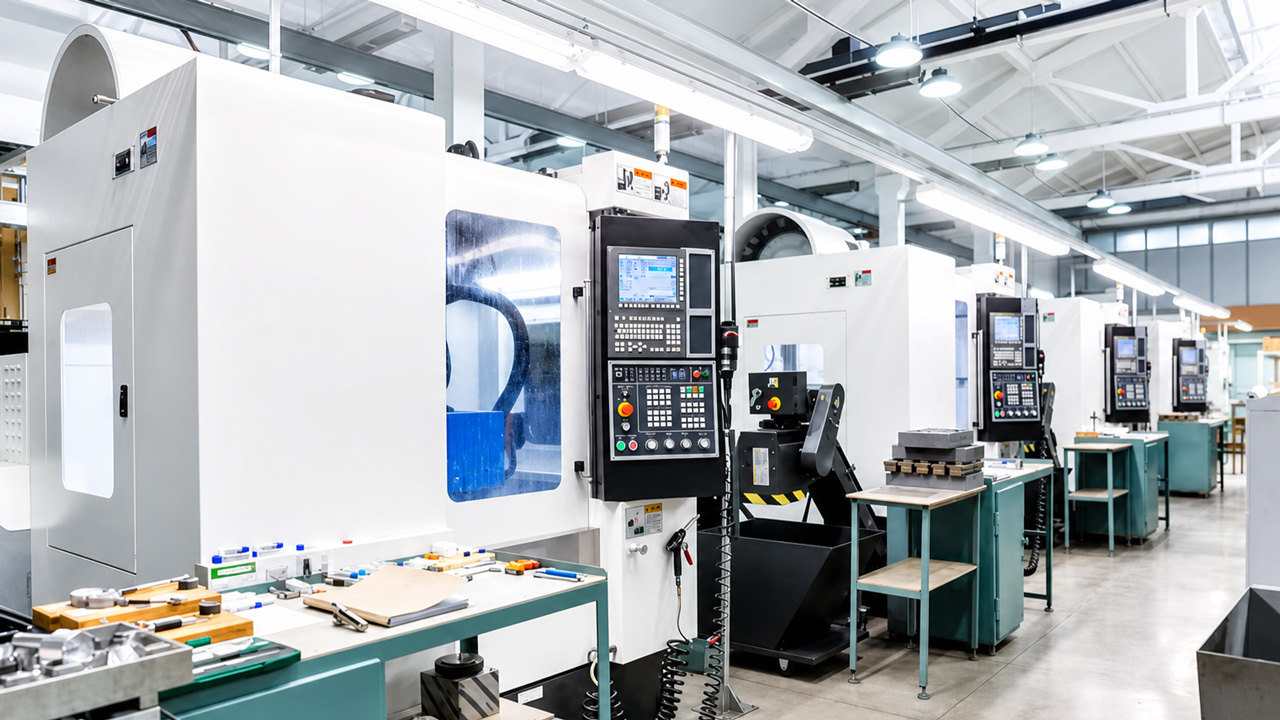
Machine tools are often called “mother machines.”
That is because a machine tool is a “machine for making machines.”
Trace back the metal parts used in automobiles, home appliances, smartphones, industrial robots — and in machine tools themselves — and you will find they were machined by machine tools.
The mother machine is the foundation on which all of manufacturing rests.
In This Article
Why It Is Called the “Mother Machine”
In the world of manufacturing, the parts used to build one product are themselves made by other machines.
Automotive engine components, for example, are machined on machine tools — and the parts that make up those machine tools were, in turn, produced on yet other machine tools.
Machine tools thus sit at the very upstream end of manufacturing, and the parts they produce flow outward into all kinds of products.
Because they are like a mother giving birth to the products that follow, machine tools came to be called “mother machines.”
Their role is so important that the performance of a country's machine tools is often said to determine the precision and productivity of its entire manufacturing sector.
The Unsung Hero Underpinning Industry
Machine tools almost never reach consumers as finished products.
Yet many of the products we use every day contain parts made on machine tools.
Examples include the tiny connectors and screws inside smartphones, automotive sensors and brake components, precision parts for medical devices, and components for semiconductor manufacturing equipment.
One of the machine tools responsible for volume production of these small, high-precision cylindrical parts is the CNC automatic lathe — the subject of this site.
The CNC automatic lathe, too, is an important machine tool carrying its share of the mother machine's role.
What Accuracy Means for a Mother Machine
Why is the accuracy of the mother machine so decisively important?
Because the accuracy of the machine doing the making sets the upper limit on the accuracy of the parts being made.
A machine tool capable of only 0.01 mm accuracy, for instance, cannot produce parts any more accurate than that.
Conversely, a machine tool that can consistently hold micron-level accuracy makes it possible to produce parts for fields that demand high precision, such as medical devices and semiconductors.
That is why machine tool manufacturers have spent decades refining the fundamental technologies that underpin accuracy: rigidity, thermal displacement countermeasures, and control technology.
In the world of CNC automatic lathes, the structure of the guide bushing, which supports long, slender workpieces right next to the cutting edge, is exactly this kind of engineering for high precision.
Japanese Manufacturing and the Mother Machine
Machine tools are often described as a symbol of national industrial strength.
Whether a country can build high-performance machine tools domestically has a major bearing on the competitiveness of its entire manufacturing sector.
Japan has long been known as one of the world's leading machine tool nations.
It has a history of producing machine tools with high accuracy and reliability, supporting the growth of industries such as automotive, electrical equipment, and precision instruments from the ground up.
In the field of CNC automatic lathes as well, Japanese manufacturers excel in the volume production of slender, high-precision parts.
The strength of its mother machines is one of the key elements sustaining the strength of Japanese manufacturing as a whole.
The CNC Automatic Lathe as a Mother Machine
Among the many kinds of machine tools, the role of the CNC automatic lathe is clear:
to mass-produce small, round precision parts with high accuracy and consistent stability.
A single smartphone contains hundreds of screws and terminals, and a single automobile incorporates an enormous number of precision parts.
If these cannot be supplied at consistent quality, the quality of the final product — and production itself — suffers.
By producing these small parts needed in large quantities, the CNC automatic lathe supports modern manufacturing from upstream.
The weight the term “mother machine” carries reflects the magnitude of this role.
Frequently Asked Questions (FAQ)
Q. Which machines exactly does the term “mother machine” refer to?
A. It is not a specific model but a name for machine tools in general — lathes, milling machines, machining centers, and so on.
They are called mother machines because they are the machines that produce machine parts.
Q. Why is machine tool accuracy so important?
A. Because the accuracy of the machine doing the making largely determines the accuracy of the parts being made.
The more an industry depends on high-precision parts, the more the accuracy and stability of the underlying machine tools matter.
Q. Is a CNC automatic lathe also a mother machine?
A. Yes.
A CNC automatic lathe is a type of machine tool, and it plays its part as a mother machine by producing small, high-precision cylindrical parts.
Summary
A mother machine is a machine tool — often described as a “machine that makes machines.”
Machine tools produce a vast range of machine parts and are essential to the precision and productivity of manufacturing as a whole.
Within that world, the CNC automatic lathe plays the role of stably mass-producing small, high-precision cylindrical parts.
For an overview of how machine tools are classified, see Main Types of Machine Tools.