
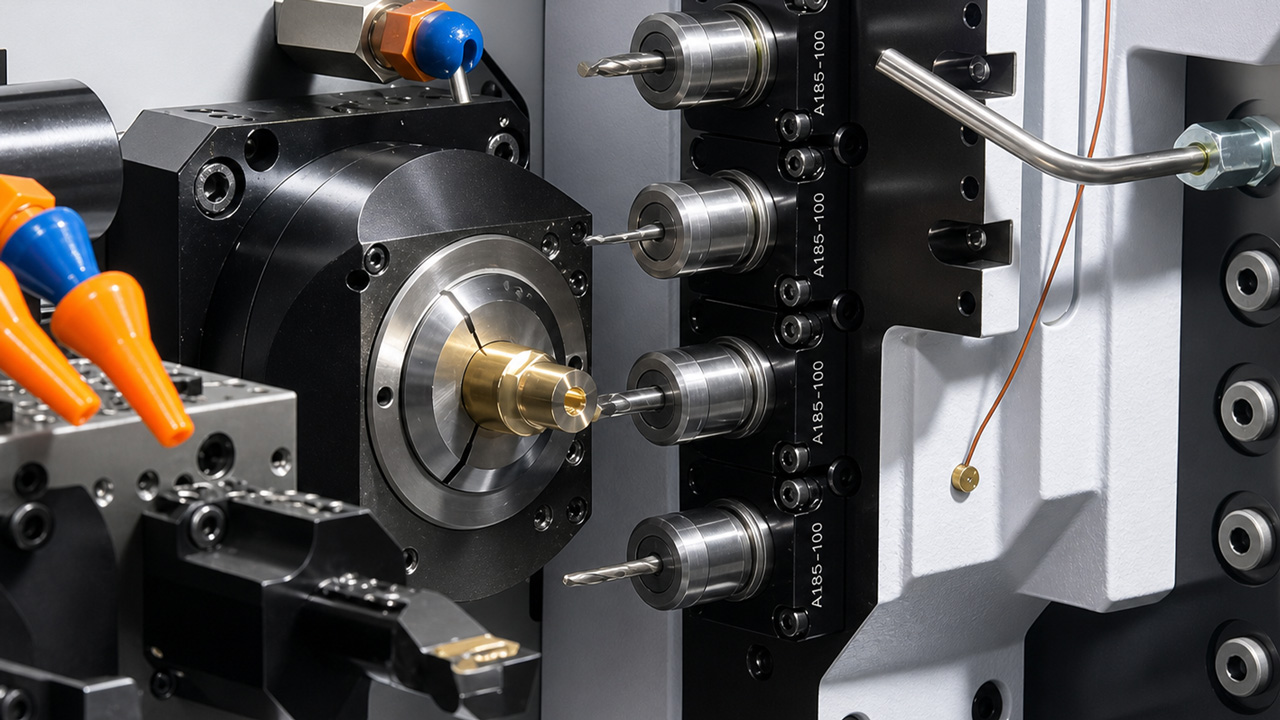
CNC automatic lathes fall into several types according to their structure.
The starting point for machine selection is the broad two-way split between the "Swiss-type" (sliding-headstock) and the "fixed-headstock" type.
Understanding this difference is the foundation for choosing the machine that fits your work.
In This Article
What Is a Swiss-Type (Sliding-Headstock) Lathe?
The Swiss-type, as the name suggests, was developed in the Swiss watch industry and is also called the "sliding-headstock" type.
Its defining features are that the main spindle (the part that grips the material) moves back and forth during machining, and that it has a guide bushing that supports the material right next to the cutting tool.
The material is machined while passing through the guide bushing, moving back and forth together with the spindle.
Because it is supported right next to the cutting edge, even a long, slender workpiece resists deflection and holds high accuracy.
This makes the Swiss-type best at machining slender, long, high-precision parts.
It shines in volume production of "small, slender, precise" parts such as shafts and screws a few millimeters in diameter, medical components, and connectors.
What Is a Fixed-Headstock Lathe?
The fixed-headstock type machines the material by rotating it in place, without the spindle traveling.
Its structure is close to that of a conventional lathe, and it generally works without a guide bushing.
Because the spindle does not move, it suits relatively large-diameter workpieces and parts whose diameter is large relative to their length.
It can also keep the remnant (bar-end) stock — unavoidable on guide-bushing setups — shorter, which can make it advantageous in terms of material yield.
It is also more tolerant of variation in bar stock diameter.
How to Choose Between Them
The choice is not about which is better, but about their respective strengths.
The key decision points can be summarized as follows.
Where the Swiss-type fits: long, slender parts (as a rule of thumb, small-diameter, long parts up to 20 mm in diameter with lengths more than three times the diameter), hair-thin precision shafts, parts requiring high straightness and roundness, and volume production of micro parts for medical, semiconductor, and connector applications.
Where the fixed-headstock type fits: relatively large-diameter, shorter parts (as a rule of thumb, parts over 20 mm in diameter or with lengths up to about twice the diameter), parts whose diameter is large relative to their length, and cases where you want to cut material costs by reducing remnant stock.
In recent years, machines with a "guide bushing conversion mechanism" have appeared that can operate both ways — Swiss-type and fixed-headstock — in a single unit, and models that switch flexibly according to the part being machined are becoming more common.
The Second Axis: Tool Post Design
Beyond the Swiss-type vs. fixed-headstock classification, there is another important axis.
That is the tool post design.
There is the "gang type," which arranges tools like the teeth of a comb, and the "turret type," which arranges them radially and indexes by rotation; the choice affects production speed and the number of tools the machine can carry.
See "Types of Tool Posts: Gang Type vs. Turret Type" for details.
Articles in This Category
- Types of Tool Posts: Gang Type vs. Turret Type
- What Is a Swiss-Type CNC Automatic Lathe?
- The Role of the Guide Bushing
- Single-Spindle vs. Multi-Spindle
Swiss-Type vs. Fixed-Headstock Comparison Table
Here are the two types side by side, compared on the criteria most often used in selection.
When choosing an actual model, use this table as a starting point and check it against your own parts.
| Comparison Item | Swiss-Type (Sliding-Headstock) | Fixed-Headstock |
|---|---|---|
| Guide bushing | Yes (supports near the cutting edge) | Generally none |
| Best-suited workpieces | Long, slender parts | Larger-diameter, shorter parts |
| Precision (slender parts) | Very high | Standard |
| Remnant (bar-end) stock | Remains longer | Can be kept short |
| Tolerance for bar diameter variation | Strict (high-precision stock required) | Relatively forgiving |
| Typical applications | Micro parts for medical, semiconductor, and connector uses | Larger-diameter shafts and volume-production parts |
It Is Not Always an Either/Or Decision
In practice, the choice of machine is not settled by "Swiss-type or fixed-headstock" alone.
For example, even among Swiss-type machines, whether the tool post is gang type or turret type changes the production speed and the complexity the machine can handle.
The number of spindles (single or multi) also directly affects output.
In other words, machine selection means combining several axes: type (Swiss-type or fixed-headstock), tool post design, and spindle count.
Start with the broad classification (Swiss-type or fixed-headstock) to get your bearings, then narrow down through tool post and spindle count, and the evaluation will proceed without confusion.
Each element is covered in detail on the individual pages of this category.
Frequently Asked Questions (FAQ)
Q. Which performs better, Swiss-type or fixed-headstock?
A. It is a difference in strengths, not a ranking.
The Swiss-type has the advantage for long, slender precision parts; the fixed-headstock type for larger-diameter, shorter parts and for reducing remnant stock.
Q. Are there machines that can handle both in one unit?
A. Yes.
Machines equipped with a guide bushing conversion mechanism can switch between Swiss-type and fixed-headstock operation depending on the part being machined.
Q. Does "sliding-headstock type" mean a Swiss-type?
A. Yes.
Because a Swiss-type machines with its main spindle (headstock) moving back and forth, it is also called the "sliding-headstock" or "traveling-headstock" type.
High-rigidity design with dovetail slideways.
Swiss-type lathes from Star Micronics
Star Micronics, which holds a world-leading share in Swiss-type CNC automatic lathes (per company press releases), uses a high-rigidity design with dovetail slideways on the tool post to deliver high-precision, high-efficiency machining with chatter suppressed.
The lineup also includes a wide range of models that convert between guide-bushing and non-guide-bushing configurations.
Summary
CNC automatic lathes divide broadly into the "Swiss-type" (sliding-headstock) and the "fixed-headstock" type: as a rule of thumb, Swiss-type for slender, high-precision work, fixed-headstock for larger diameters and remnant reduction.
Characteristics also vary with the tool post design and the number of spindles.
Start from the geometry, precision, and production volume of your key parts and narrow down to the type that fits best.