
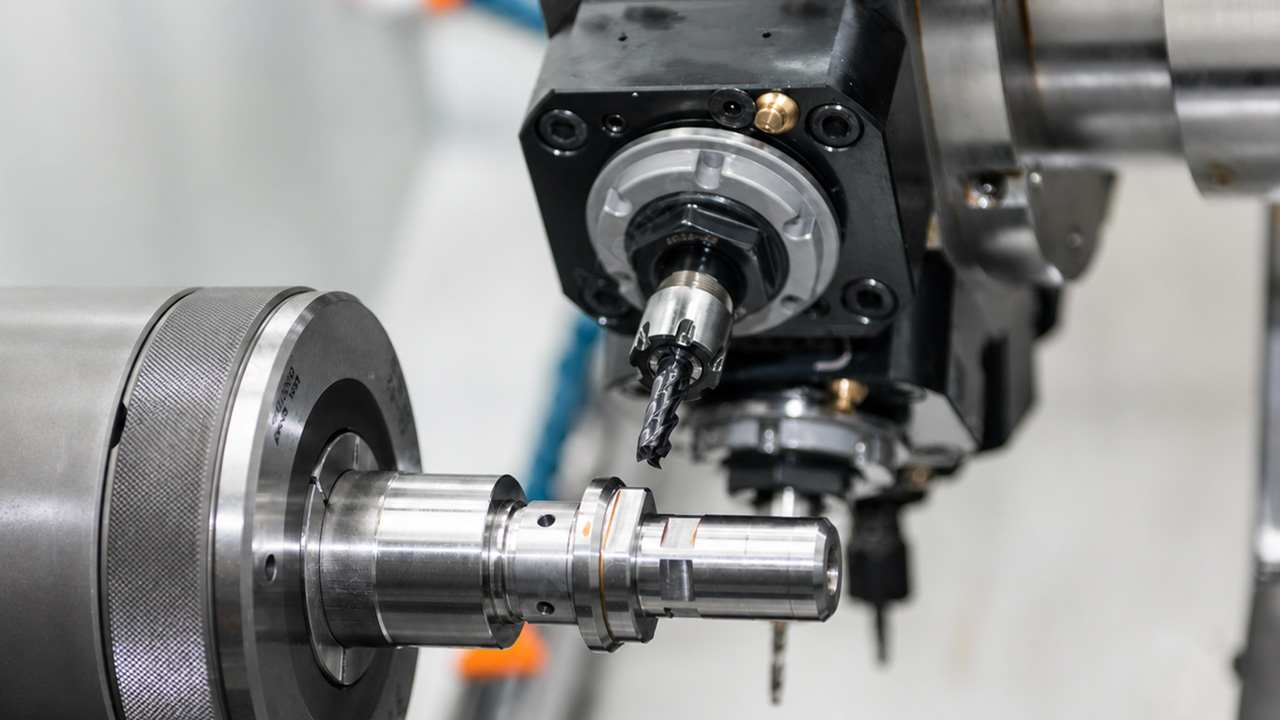
A turret-type lathe is a lathe that machines by rotating a "turret" holding multiple radially arranged tools and indexing the tool it needs.
The word "turret" originally referred to a rotating gun turret — and true to the name, a tool-laden mount rotates to select the tool in use.
In This Article
How the Turret Type Works
A turret is polygonal (hexagonal, octagonal, etc.) or disc-shaped, with tools mounted on each face or station.
When the machining program calls for the next tool, the turret rotates to index that tool into the cutting position and machining proceeds.
Thanks to this rotate-to-select mechanism, one machine can carry a large number of tools.
Load it with OD turning tools, cut-off tools, drills, and various live tools, and a single workpiece can receive one operation after another.
Advantages of the Turret Type
Large Tool Capacity
Its greatest advantage is the number of tools it can carry.
Even for complex parts with many operations, loading every needed tool onto the turret makes it easier to complete machining in a single setup.
Strong in High-Mix and Complex Shapes
With a rich variety of tools on hand, it responds flexibly to complex part shapes and high-mix production.
The turret type readily answers the need for "many kinds of operations on many kinds of parts."
Rigidity Is Easier to Secure
The turret structure also holds tools firmly, making it easier to secure rigidity during machining.
Points to Watch
On the other hand, because the turret must rotate for every tool change, tool-change time (non-cutting time) tends to run somewhat longer than on a gang type.
For extremely simple parts that just need to be made fast and in volume, the gang type may hold the advantage.
What Work It Suits
The turret-type lathe suits complex parts requiring many tools and high-mix machining.
It shines when one part needs many operations — threading, drilling, grooving, milling — or when you want one machine to handle many different kinds of parts.
Note that some CNC automatic lathes combine a gang tool post with a turret.
By splitting the roles — front machining done fast on the gang tool post, back machining and complex work on the turret — they achieve both speed and flexibility.
Where the Turret Type Gets Chosen
The turret type's strengths pay off on floors where one part needs many operations, or where one machine must produce many different parts.
Take a part that concentrates OD turning, facing, multiple drilled holes, threading, grooving, and milling in a single piece.
Load every needed tool onto the turret and the job can be completed in one setup.
Likewise, on high-mix, low-volume floors running many part types in small lots, the turret type's wide tool selection adapts flexibly to changeovers.
Remember the turret type as the design that is strong in complexity and variety.
How to Think About Tool-Change Time
The turret type's noted weakness is the time spent rotating the turret at every tool change.
In practice, though, this difference mainly matters when producing extremely simple parts in enormous quantities.
With complex parts, the machining itself takes time, so tool-change time becomes a relatively small share of the total.
Moreover, recent advances — faster turret indexing, preparing the next tool while machining — keep shrinking tool-change losses year by year.
Understanding that for complex parts the turret type's change time is not much of a handicap makes selection decisions easier.
Frequently Asked Questions (FAQ)
Q. Which is more versatile, the turret type or the gang type?
A. The turret type, with its larger tool capacity and support for diverse operations, is the more versatile.
For strictly high-speed volume production of simple shapes, however, the gang type has the advantage.
Q. How many tools can a turret hold?
A. It varies by model, but since tools mount at each station, a turret generally carries more tools than a gang tool post.
The more complex the part, the more this advantage counts.
Q. Is the turret type found on Swiss-type or fixed-headstock machines?
A. Both.
The tool post design (turret or gang) and the machine type (Swiss-type or fixed-headstock) are separate classification axes.
Summary
The turret-type lathe indexes many tools by rotation and excels at high-mix and complex-shape machining.
Tool changes take somewhat longer, but for complex parts the difference is small and the appeal of its flexibility and tool capacity wins out.
Compare it with the gang-type lathe, a high-speed volume-production specialist, and choose the design that fits your machining.