
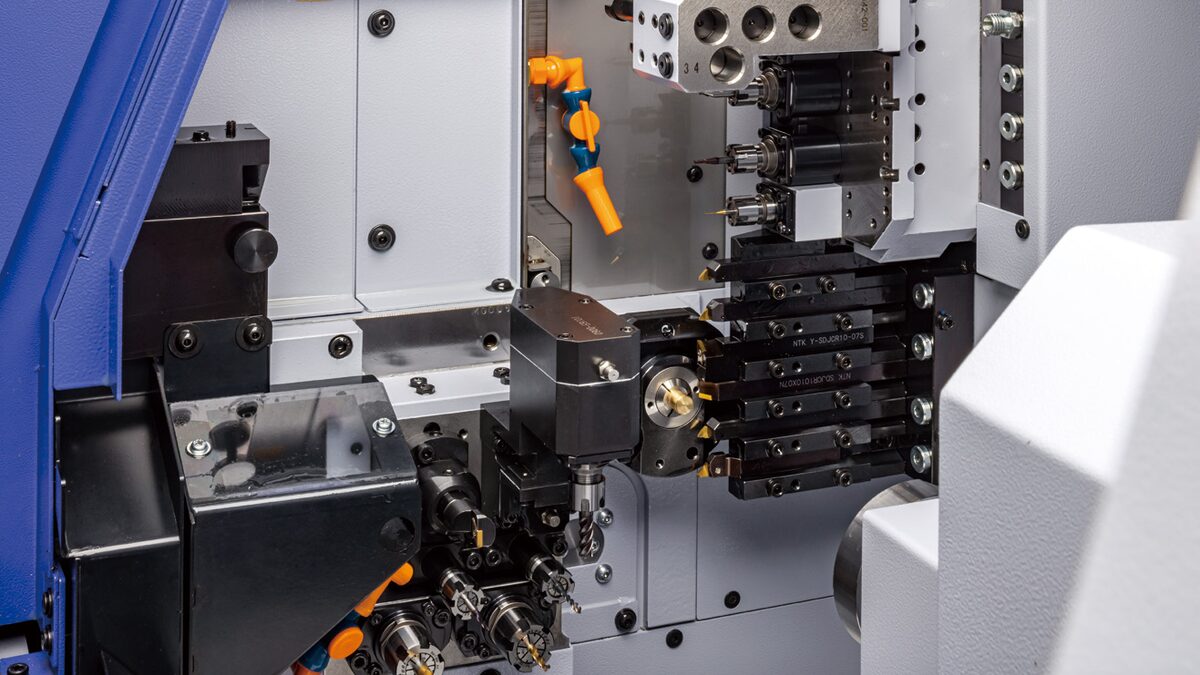
A gang-type lathe is a lathe whose tools are fixed in a single row, like the teeth of a comb, and switched by sliding the tool post.
In English this arrangement is called "gang tooling."
It is a design that comes into its own in volume production — making parts fast, and in great numbers.
In This Article
How the Gang Type Works
On a gang tool post, tools such as OD turning tools, cut-off tools, and drills are mounted side by side in a single row.
The Japanese name "kushiba" (comb blade) comes from its resemblance to the teeth of a comb.
During machining, the tool post slides vertically and horizontally to bring the desired tool to the workpiece.
Because the tools sit in one row, switching to the next tool — or one a little farther away — is just a matter of moving the tool post.
With no turret-style rotation required, wasted motion in tool switching is minimal.
Advantages of the Gang Type
Fast Tool Changes Mean Short Cycle Times
Its greatest strength is short tool-change time (non-cutting time).
Because tools switch with nothing more than a slide, the time to finish one part (the cycle time) is reduced.
The difference per part may be tiny, but over tens of thousands of parts it becomes a major difference in productivity.
Ideal for High-Speed Mass Production
With its short cycle times, it is ideal for producing relatively simple small parts fast and in large volumes.
It is widely used in the volume production of high-count precision parts such as connector components, pins, and small-diameter screws and shafts.
A Good Match for the Swiss-Type
The gang type is often combined with the Swiss-type (sliding-headstock), which excels at slender, high-precision work.
It underpins the automatic lathe's strongest domain: high-speed volume production from thin bar stock.
Points to Watch
There is a physical limit to how many tools can be lined up in a row.
For complex parts that require a very large number of tools, the higher-capacity turret type may therefore be the better fit.
Their strengths divide cleanly: the gang type does "simple shapes, fast," while the turret type handles "complex shapes, with tool count."
What Work It Suits
The gang-type lathe suits high-speed mass production of simple small parts.
It is the perfect fit when shapes are not especially complex but quantities are large and you want to shave every possible second off per-part machining time.
How Shorter Cycle Times Generate Profit
The concept essential to understanding the gang type's value is "cycle time."
Cycle time is the time it takes to finish one part.
In volume production, these small time differences accumulate into a large gap.
Suppose you save 0.5 seconds of tool-change time per part.
Trivial for a single part — but at tens of thousands of parts a day and millions a year, it becomes an enormous difference in production capacity.
By handling tool changes with nothing more than a slide, the gang type trims this cycle time, which means making more parts in the same time — lowering the cost per part.
These economics are why the gang type is chosen on high-speed production floors.
Parts That Suit the Gang Type
The gang type shines most with parts that are simple in shape, need relatively few operations, and are produced in very large numbers.
Typical examples are small, high-count precision parts such as connector pins and terminals, small-diameter screws, shafts, and bushings.
Combined with the Swiss-type, a specialist in slender-part volume production, these can be mass-produced at overwhelming speed while holding high precision.
If your core parts fit this "simple, small, high-volume" profile, the gang type is a strong candidate.
Frequently Asked Questions (FAQ)
Q. What is the biggest advantage of the gang type?
A. Tool-change speed.
Because tools are switched by a simple slide, cycle times are shorter, making it well suited to high-speed mass production of simple parts.
Q. Does the gang type have drawbacks?
A. The number of tools that fit in a single row is limited, so it may not suit complex parts requiring a very large number of tools.
In such cases, the turret type is the alternative.
Q. Is the gang type common on Swiss-type automatic lathes?
A. Yes.
The Swiss-type, which mass-produces slender parts at high speed, pairs well with the fast-tool-change gang type, and the two are often used together.
Summary
The gang-type lathe lines tools up like a comb and switches them with a quick slide, minimizing tool-change time and enabling high-speed mass production.
Shorter cycle times translate directly into profit on the production floor.
It also pairs well with the Swiss-type, a specialist in slender-part volume production, and supports the mass production of precision small parts.
Consider it alongside the turret-type lathe, which is strong in complex machining, and choose the tool post that fits your parts.