
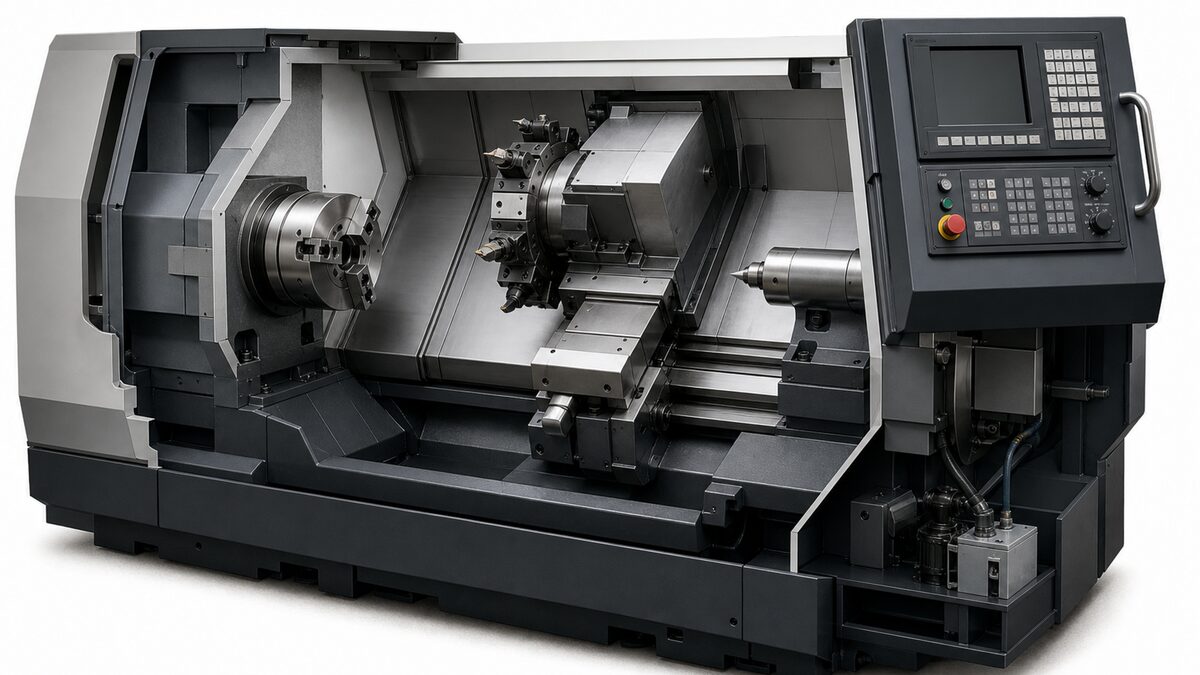
What place will the CNC automatic lathe occupy in the manufacturing industry of the future?
When evaluating a capital investment, it is important to understand not only your immediate machining needs but also the broad currents of the market.
This page organizes the demand trends and outlook surrounding CNC automatic lathes from several angles.
In This Article
Please note
This page describes general market trends.
For specific statistics, please refer to the latest publications from research organizations and industry associations.
Three Major Trends Supporting Demand
Demand for CNC automatic lathes rests on several structural trends in the manufacturing industry.
① Smaller, higher-precision products — Smartphones, medical devices, semiconductors, EVs: products of every kind are becoming smaller and more sophisticated.
With that comes ever-growing demand for the precision small parts inside them.
This is exactly the CNC automatic lathe's home territory.
② Labor shortages and labor savings — Labor shortages in manufacturing are becoming severe, and raising productivity with fewer people is a shared challenge.
The CNC automatic lathe, which can mass-produce unattended, is drawing attention as a core piece of equipment for labor savings and automation.
③ Automation and the smart factory — Amid the trend toward digitizing and automating entire factories, CNC automatic lathes too are evolving toward more advanced automation, linking with peripheral equipment and systems.
Technical Progress Is Widening the Market
The evolution of the CNC automatic lathe itself is also expanding the market.
Richer multitasking capability means more complex parts can be finished on a single machine, consolidating operations that used to require several machines.
Advances in chip-control technologies such as oscillation cutting, and in the peripheral equipment that supports unattended operation, have made difficult-to-cut materials and long unattended runs easier to handle.
These advances broaden the range of machining a CNC automatic lathe can take on, creating new applications and new markets.
Investing with the Future in Mind
Given these trends, demand for CNC automatic lathes can be expected to remain firm as products grow more sophisticated and labor savings advance.
When evaluating an investment, choosing a machine with an eye not only to the parts you want to make now but also to the precision, complexity, and automation that will be demanded in the future leads to equipment that stays useful for years.
On the cost side, making use of subsidies and grants that support labor savings and productivity improvement is another option.
Combining the market tailwind with the available support programs makes a forward-looking investment easier to make.
The Bigger Picture: Overseas Markets
No discussion of the CNC automatic lathe market is complete without the overseas market.
Japanese machine tools are highly regarded worldwide for their quality and precision, and many domestic manufacturers earn a substantial share of their sales abroad.
Globally, the industrialization of emerging economies and the growth of the electronics, automotive, and medical industries in country after country continue to generate demand for CNC automatic lathes.
For Japanese manufacturers, overseas markets are a major growth market.
Nor is this irrelevant to domestic manufacturers.
Whether producing parts overseas or competing on quality with foreign makers, mastery of high-precision CNC automatic lathes is a source of competitiveness.
Viewing the market from a global perspective is becoming important in thinking about future capital investment and business strategy.
Frequently Asked Questions (FAQ)
Q. Will demand for CNC automatic lathes keep growing?
A. Supported by smaller, higher-precision products, labor-saving needs driven by labor shortages, and the trend toward automation, demand is expected to remain firm.
For specific figures, please refer to research organizations' publications.
Q. What kind of machine should I choose with the future in mind?
A. Choosing with an eye not only to the machining you need now but also to future demands for precision, complexity, and automation leads to equipment that stays useful for years.
Multitasking capability and expandability toward automation are useful yardsticks.
Q. Is there a way to reduce the burden of the investment?
A. Making use of subsidies and grants that support labor savings and productivity improvement is one option.
See the Subsidies & Support guide for details.
Summary
The market for CNC automatic lathes is supported by structural trends — smaller and higher-precision products, labor savings driven by labor shortages, and advancing automation — and firm demand is expected.
Technical progress is widening the range of applications and creating new markets.
Forward-looking machine selection and the use of support such as subsidies are the keys to a smart investment.
For industry-by-industry applications, see Industries Using CNC Automatic Lathes.