
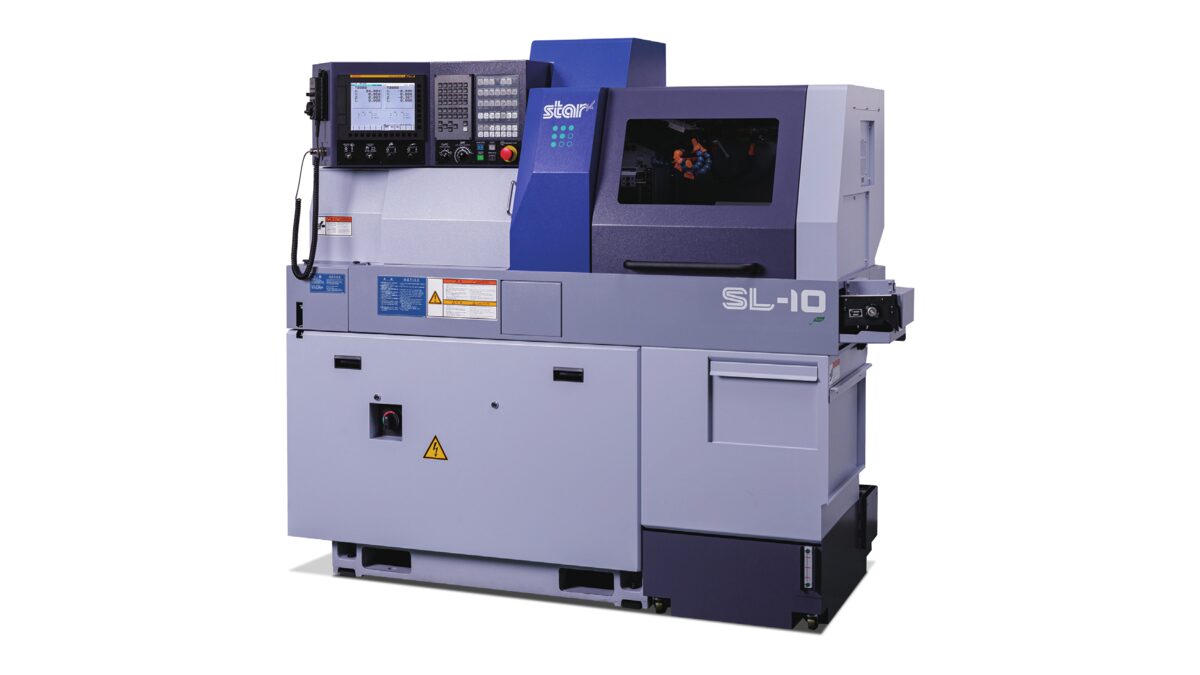
Shafts are rod-shaped parts that transmit rotation and power — fundamental components found in virtually every machine, from automobiles to office equipment and industrial machinery.
They look simple, but their thin, long geometry gives their machining a distinctive set of challenges.
This page explains the key points of turning shafts.
In This Article
Why Shafts Are Difficult to Machine — Deflection and Runout
The biggest challenge in shaft machining is the deflection and runout characteristic of long, slender workpieces.
In turning, the longer the distance from the point where the material is supported to the cutting edge, the more the cutting forces bow the material.
A thin, long shaft is exactly the shape in which this deflection occurs most readily.
Cutting a deflected workpiece throws dimensions off and degrades roundness and straightness.
Long, slender workpieces are also prone to runout as they rotate, which disturbs machining accuracy.
In short, the key to quality in shaft machining is suppressing deflection and runout so the part is cut straight and to high precision.
Key Machining Points
Selecting and Adjusting the Guide Bushing
To machine long, slender shafts consistently, the selection and adjustment of the guide bushing that supports the workpiece near the cutting edge is critical.
If the guide bushing's inner diameter does not match the material diameter, support becomes unstable and runout and deflection occur more easily.
Conversely, if the clearance is too tight, it can cause feeding problems, scratches on the material, or heat buildup.
Choose the guide bushing to suit the shaft's diameter and length and the OD accuracy of the bar stock, and adjust it so the material feeds smoothly while remaining firmly supported during machining.
Optimizing Cutting Conditions
Reducing the machining forces (cutting resistance) is another effective way to suppress deflection.
Techniques such as taking lighter depths of cut over multiple passes and choosing appropriate tools can reduce deflection through cutting-condition adjustments.
Separating roughing from finishing and leaving an appropriate finishing allowance also helps ensure precision.
Controlling Runout and Straightness
In shaft machining, keeping post-machining straightness and runout stable is important.
Long, slender shafts in particular are susceptible to deflection and vibration during machining and to residual stress in the material, and can end up slightly bent after machining.
It is therefore important to support the workpiece properly during machining and to avoid overly aggressive cutting conditions.
Splitting the work into separate operations where necessary and checking the condition of the material also make it easier to limit variation in straightness and runout.
In addition, when the as-supplied bar surface remains on the finished product, the straightness of the raw material itself becomes extremely important.
Torsion and Bending Loads on Shafts
Because shafts transmit rotation and power, they are subjected to torsional and bending forces in service.
Machining quality directly affects this in-service performance.
For example, if a shaft is bent or lacks straightness, it will run out as it rotates, causing vibration, noise, and premature bearing wear.
Scratches or machining flaws on the surface can become the starting point for fatigue failure.
That is why straightness and surface quality are given particular weight in shaft machining.
Likewise, the dimensional accuracy and roundness of fitting sections (where bearings and gears are mounted) determine assembly precision.
What makes shaft machining so deep is that "just getting it cut" is not enough — the quality must reflect how the part will be used.
Frequently Asked Questions (FAQ)
Q. What is the biggest challenge in shaft machining?
A. The deflection and runout characteristic of long, slender workpieces.
Suppressing them and cutting straight to high precision is the key to ensuring quality.
Q. Why are Swiss-type lathes well suited to shaft machining?
A. Because the guide bushing supports the workpiece close to the cutting edge, the overhang stays short and deflection is suppressed.
The longer and more slender the part, the greater the benefit.
Q. How should cutting conditions be set to suppress deflection?
A. Effective approaches include reducing the depth of cut and machining in multiple passes, and choosing tools with low cutting forces.
Separating roughing and finishing also helps ensure precision.
Q. How do you control the precision of fitting sections?
A. In fitting sections where bearings or gears are mounted, dimensional accuracy and roundness determine assembly precision.
Clarify the tolerance range before machining, and check dimensional changes during machining with methods such as in-machine measurement.
Applying tool offsets or changing tools based on the measurement results makes it easier to hold the target precision.
Summary
When machining shafts on an automatic lathe, the priority is suppressing the deflection and runout to which long, slender workpieces are prone.
The guide bushing that supports the material near the cutting edge must be selected and adjusted to match the material diameter and OD accuracy, maintaining an appropriate clearance.
Combined with reasonable cutting conditions and control of straightness, runout, and the dimensional accuracy and roundness of fitting sections, this leads to stable, high-precision machining.
For machining other parts, see Turning by Part Type.