
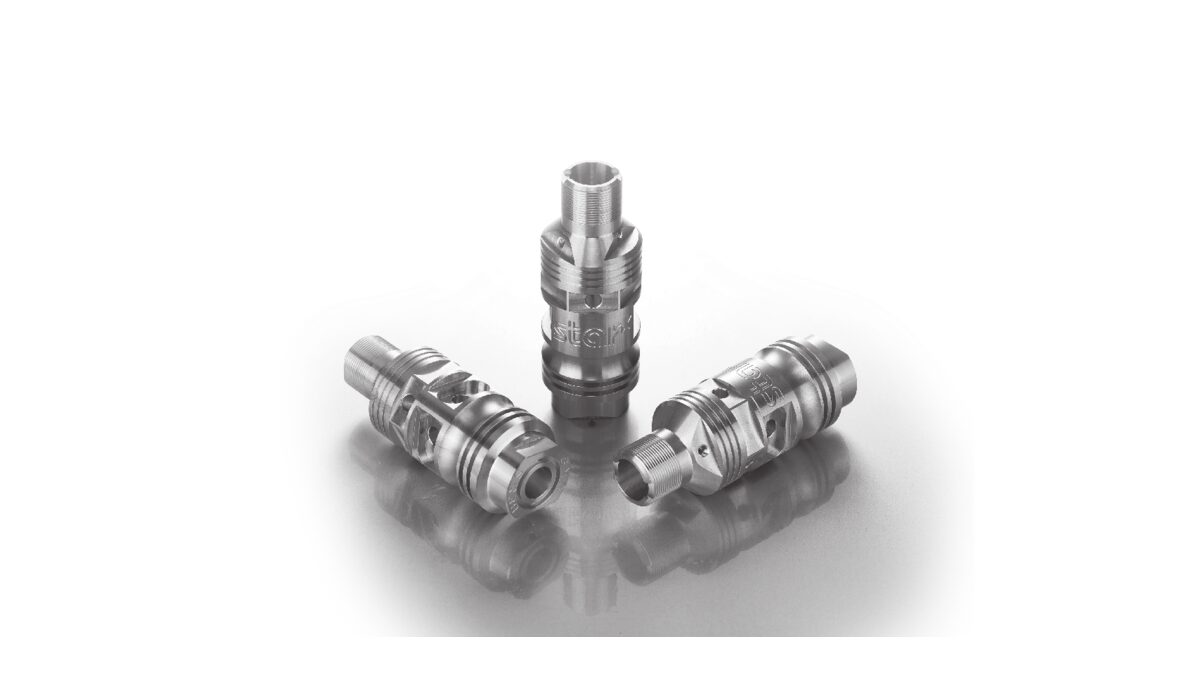
Nipples are fittings threaded on both ends, used to connect pipes and hoses.
They are staple parts found across a wide range of fields, from water supply to pneumatic and hydraulic systems and all kinds of piping installations.
Their shape is relatively simple, but two factors — threading and volume production — are the keys to machining them.
In This Article
What Characterizes Nipple Machining
Nipple machining has the following characteristics.
First, threading is central.
Nipples usually carry threads on both ends, or on both the inside and outside, and thread quality determines the strength and sealing of the connection.
If the thread profile, dimensional accuracy, or the finish of the seating surfaces is inadequate, the result can be loose connections or fluid leaks.
Second, they are volume-production parts.
Because nipples are general-purpose parts used in large quantities, they must be made efficiently and inexpensively while maintaining stable quality.
Key Machining Points
Thread Quality
Threading is the heart of nipple machining.
Cutting clean threads consistently requires selecting the right tools (threading tools or dies) and cutting conditions.
Thread-profile accuracy and surface quality determine how securely the connection holds and how well it seals.
On a CNC automatic lathe, threading is program-controlled and stable, so quality stays uniform even in volume production.
Ensuring Volume Productivity
Because nipples are mass-produced, shortening the machining time per piece (cycle time) is important.
Efficient volume production is achieved by using a gang-type tool post with fast tool changes, and by feeding bar stock automatically for unattended operation.
The strength of a CNC automatic lathe is that the entire sequence — including cutting the part off with a cutoff operation — can be completed on one machine.
Chip Control
Nipples are often made from free-machining steel or brass — materials that tend to produce long, continuous chips.
When long chips tangle around the threads or the workpiece, they cause quality problems and shut down unattended operation.
Breaking chips up with techniques such as oscillation cutting enables stable volume production.
Know Your Thread Types and Standards
In nipple machining, it is essential to understand exactly what thread you are cutting.
There are many thread types and standards, used selectively depending on the application.
For piping, for example, taper pipe threads (PT and R threads, etc.), which prioritize air-tightness, are commonly used — tightening them creates the seal.
For general fastening, metric threads (M threads) are used.
A different thread standard means a different pitch (thread spacing), profile, and machining method.
Correctly reading the thread standard specified on the drawing and choosing tools and machining conditions to match is the prerequisite for quality.
With piping nipples in particular, the air-tightness of the threads translates directly into leakage, so accurate, standard-conforming threading is required.
A solid grounding in thread fundamentals is the foundation of nipple machining.
Frequently Asked Questions (FAQ)
Q. What is the most important point in nipple machining?
A. Thread quality.
Thread-profile accuracy and surface quality determine how securely the connection holds and how well it seals.
Stable threading defines the part's function.
Q. How can costs be kept down in volume production?
A. Nipples are small parts machined in large quantities, so controlling material loss matters as much as per-piece machining time.
Reviewing the cutoff width and the machining sequence to reduce remnant stock and unnecessary machining allowance helps keep both material cost and machining time down.
Q. How do you prevent chip-entanglement problems?
A. Free-machining steel and brass tend to produce long, stringy chips, so techniques such as oscillation cutting are used to break chips into small pieces and keep them from tangling around the threads or the workpiece.
Q. How should thread standards be confirmed?
A. Accurately reading the thread standard specified on the drawing (taper pipe threads, metric threads, etc.) and selecting tools and conditions that match the pitch and profile is the prerequisite for quality.
Summary
When machining nipples on an automatic lathe, it is important to keep three things in view: quality, productivity, and cost.
On quality, thread-profile accuracy and surface quality determine how securely the connection holds and how well it seals, so the thread standard must be read correctly and the right tools and cutting conditions selected.
On productivity, the point is to prevent stoppages from chip entanglement and tool wear and maintain stable continuous machining.
On cost, shortening cycle time, reducing material loss, and cutting defects and rework are key to keeping the machining cost per piece down.
For machining other parts, see Turning by Part Type.