
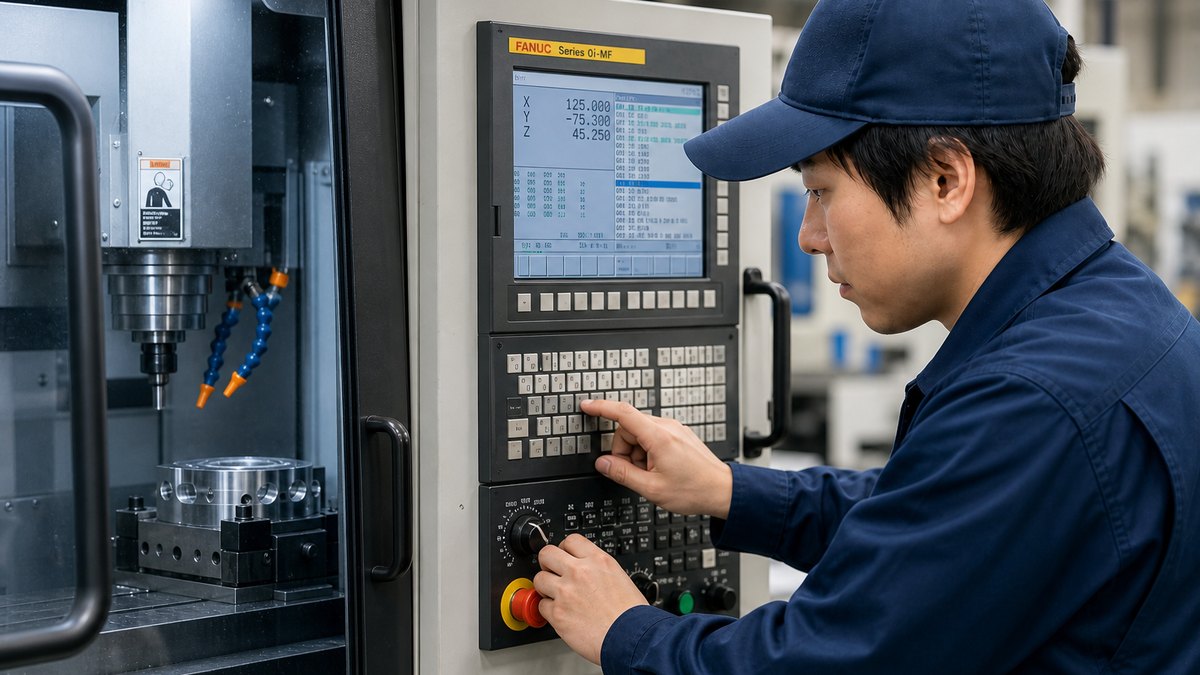
To the new hires and young staff who have just been assigned to the shop floor and are facing an automatic lathe for the first time: the flood of technical terms may feel overwhelming at first, but you will be fine. This page gently summarizes the "basics of the basics" to pick up first on the shop floor. Learn them one at a time and you will get along with the automatic lathe in no time.
In This Article
Basic Terms to Learn First
There is a minimum set of terms you need in order to follow conversations on the shop floor.
Workpiece — the material or part being machined. Spindle — the heart of the machine, which grips and rotates the material. Cutting tool / insert — the tool that cuts the material. Bar feeder — the device that automatically feeds long bar stock. Guide bushing — on a Swiss-type, the part that supports the material close to the cutting edge. Setup — the preparation work before machining begins. Cutting speed, feed, and depth of cut — the three elements that define cutting conditions.
These words come up every day on the shop floor. Whenever you meet a term you do not understand, check it right away and build your vocabulary gradually. Our Basics category is also a helpful reference.
Setup Is the Heart of the Job
Work on an automatic lathe is less about running the machine than about the "setup" that comes before it. Setup means the whole sequence of preparation: understanding the drawing, preparing the machining program, setting the tools, loading the material, and confirming with a trial cut.
If the setup is done accurately, the machine will quietly turn out parts on its own. If there is a mistake in the setup, you may produce a pile of defective parts or bring the machine to a halt. As the Japanese shop-floor saying goes, "setup is 80% of the job" — it is no exaggeration to say the quality of the work is decided by the setup. Even if it takes time at first, build the habit of checking carefully.
Safety Comes First
Above all else on the shop floor comes safety. An automatic lathe spins material at high speed and cuts it with sharp tools. Rotating parts, chips, and cutting edges are all hazards.
The basic rules: never bring your hands near a rotating spindle or workpiece; always stop rotation before opening the machine door to work; never touch chips with bare hands (they are sharp and hot); and follow the prescribed procedures and wear protective equipment. Thinking "this much is fine" is what leads to accidents. If anything is unclear or worrying, always check with a senior colleague or supervisor before acting.
Make a Habit of Asking and Looking Things Up
At first, it is only natural that almost everything is unfamiliar. What matters is not leaving questions unresolved: build the habit of asking and looking things up. Ask senior colleagues, of course, and also use information sources like this site to learn the fundamentals.
Learn step by step — the big picture in Getting Started with Automatic Lathes, the mechanisms in Basics, and practical know-how in the technical columns — and your skills will grow steadily.
Get Into the Habit of Asking "Why?"
As you get used to the work, it is easy to slip into simply operating the machine as instructed. But if you aim to become an engineer who is one step ahead, it is important to develop the habit of asking "why these conditions?" and "why this procedure?"
Ask why a particular cutting speed is used, for example, and the relationship between material and tool comes into view. Ask why a particular check is done during setup, and you see how it prevents trouble. Once you understand the reasons, you can make your own judgments when conditions change. The difference between someone who can only follow the manual and someone who understands the principles and can apply them comes from this habit of asking "why?"
Not knowing at first is completely normal. Ask your seniors "why?" openly, learn the principles in our Basics and technical columns, and grow, step by step, into a "thinking engineer."
Frequently Asked Questions (FAQ)
Q. I have no experience. Can I keep up with automatic lathe work?
A. Absolutely. Everyone starts with no experience. Learn the basic terms, setup, and safety rules one at a time and you will pick it up steadily.
Q. What should I learn first?
A. The basic terms and the safety rules. Then learn the flow of setup, and the overall picture of the work on the shop floor will come into focus.
Q. The technical terms are hard to remember.
A. You do not need to memorize everything at once. Check each term as it comes up on the shop floor, fill in the gaps with our Basics category, and build your vocabulary little by little.
Summary
What a new hire should learn first are the basic terms, the flow of setup, and the safety rules. Setup in particular is the heart of the job, and safety takes priority over everything. Build the habit of asking and looking things up, make use of the categories on this site, and learn the automatic lathe one step at a time. For the big picture, start with Getting Started with Automatic Lathes.