
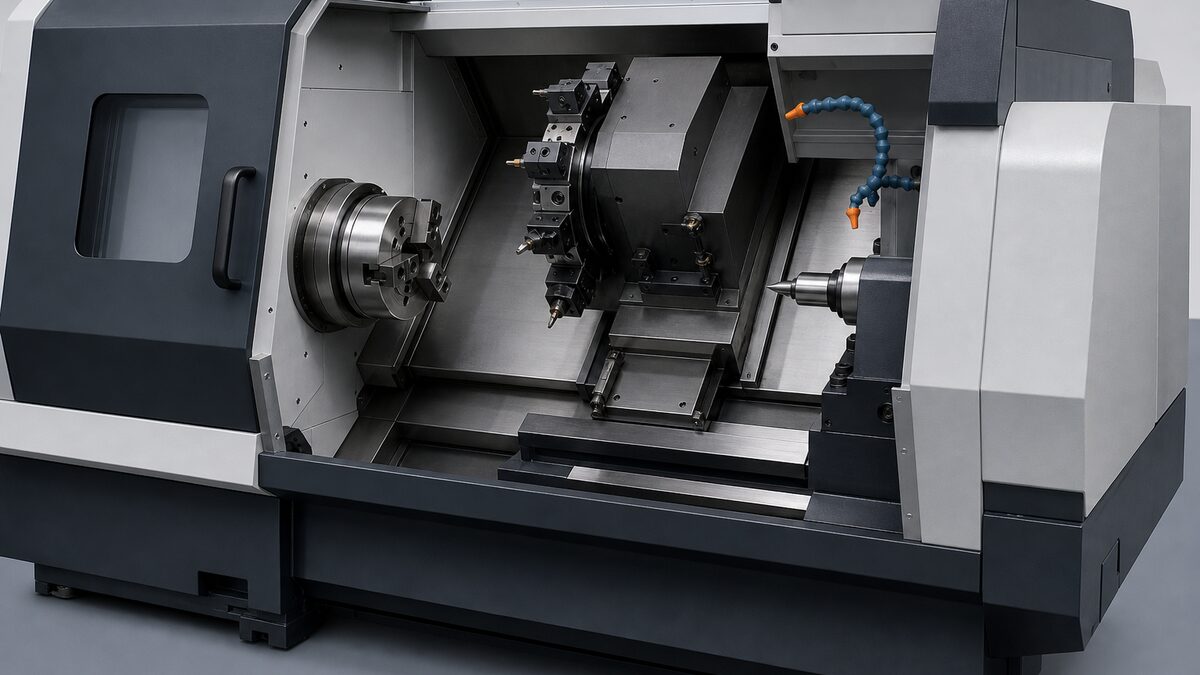
An automatic lathe is a lathe that feeds metal bar stock automatically and machines it continuously under computer control. Nobody has to load each piece of material or operate the tools by hand — the machine keeps producing parts on its own. It excels at producing small precision parts in large volumes at a consistent quality.
In This Article
This article explains how an automatic lathe works and how it differs from an ordinary lathe, in a way that makes sense even if this is your first encounter with one.
First, What Is a Lathe?
To understand the automatic lathe, you first need the basics of the lathe itself. A lathe is a machine tool that rotates the material and cuts it by bringing a cutting tool against it. As the tool approaches the spinning material, the outer surface and end faces are cut away — much like shaping a pot on a potter's wheel — producing cylinders, threaded forms, and other "round parts."
A familiar comparison is sharpening a spinning pencil by holding a blade against it. The lathe is the fundamental machine for making parts with a round cross-section.
What an Automatic Lathe Adds to a Lathe
On an ordinary (conventional) lathe, the operator clamps the material in a chuck, turns handwheels to move the tool, and swaps in the next piece of material when cutting is finished. Because every piece is handled by hand, making thousands of identical parts takes an enormous amount of labor.
The automatic lathe adds two major forms of automation to this process.
The first is automatic material feeding. An automatic lathe is equipped with a bar feeder (material feeding device) that pushes long bar stock into the machine from behind. Each time a part is cut from the bar, the bar is advanced by exactly the amount consumed and the next part is machined — repeated until the bar runs out. Because no operator has to stand by to swap material, unattended operation at night and on weekends becomes possible.
The second is CNC (computer numerical control). CNC is a system that controls the movement of the tools and spindle numerically, by program. Once the shapes and dimensions to be machined are entered as a program, the machine moves the tools exactly as instructed and keeps producing identical parts with minimal dimensional variation. A machine equipped with this control is called a "CNC automatic lathe."
The Basic Machining Flow
Actual machining proceeds roughly as follows. First, the drawing is read to understand what needs to be machined, and a machining program is written from it. The program is transferred to the machine, the required tools are set in their positions, and the bar stock is loaded into the feeder. Rather than going straight into production, a dry run or trial cut is used to confirm motion and dimensions; if everything checks out, unattended operation begins.
How accurately this preparation (called "setup") is carried out is the key to successful unattended operation. Once the setup is right, the machine simply keeps turning out the same part, over and over.
What Automatic Lathes Are Good At
What the automatic lathe does best is make large quantities of small, round, identical parts from long, thin bar stock. Typical examples are shafts, screws, pins, and connector parts a few millimeters in diameter. Once the setup is established, thousands or tens of thousands of parts can be produced while holding high precision, which is why these machines are used so widely wherever "small precision parts in large numbers" are made — connectors, medical parts, automotive parts, and parts for semiconductor manufacturing equipment.
On the other hand, setup and adjustment are demanding, and the machine is sensitive to variation in bar diameter, so preparing for production requires specialist knowledge. These points are covered in detail in Basics to Know Before You Buy.
Everyday Products Made with Automatic Lathes
Told that a part was "made on an automatic lathe," most of us would not give it a second thought in daily life. In reality, though, we are surrounded by parts produced on automatic lathes.
Take the smartphone. Inside are countless tiny connector pins joining circuit boards, and minuscule screws holding the casing together; many of these are mass-produced on automatic lathes. In cars, they appear in sensor housings, precision parts around the fuel injection system, and safety parts in brakes and airbags. In medicine, they include bone screws for fixing fractures, dental implants, and endoscope components. Add connectors and terminals for semiconductor manufacturing equipment and parts for data centers, and it becomes clear that the more advanced the industry, the more it relies on the precision machining of the automatic lathe.
What all of these have in common is that they are small, they include round features, and they are needed in large numbers at a consistent quality. That is precisely the automatic lathe's home territory, and it shows how indispensable this machine is to modern manufacturing.
Automatic vs. Conventional Lathes (Comparison Table)
Here is a summary of everything so far, contrasted with the conventional lathe.
| Comparison | Conventional lathe | CNC automatic lathe |
|---|---|---|
| Material loading | Swapped by hand, one piece at a time | Fed automatically by a bar feeder |
| Tool operation | Manual, by the operator | Automatic, by program |
| Best suited to | One-offs and small lots | Volume production of identical parts |
| Unattended operation | Not possible | Possible (runs nights and weekends) |
| Preparation required | Manual operation each time | Setup and programming in advance |
The roles are clearly divided: the conventional lathe "makes one part carefully," while the automatic lathe "makes the same part in volume."
Frequently Asked Questions (FAQ)
Q. Should a beginner learn about ordinary lathes or automatic lathes first?
A. We recommend first grasping the basic idea that a lathe is a machine that rotates the material and cuts it with a tool, and then moving on to the automatic lathe. Because an automatic lathe is a lathe with automation added, understanding the lathe's principle makes the rest much quicker to grasp.
Q. Are an "automatic lathe" and a "CNC automatic lathe" different things?
A. They refer to almost the same thing. Virtually all automatic lathes today are CNC (computer-controlled), so "automatic lathe" on its own generally means a CNC automatic lathe.
Q. What materials can an automatic lathe cut?
A. Mainly metals such as steel, stainless steel, aluminum, and copper, but non-metals such as plastics can also be machined. See What a CNC Automatic Lathe Can Do for details.
Summary
An automatic lathe is a machine tool that adds automatic material feeding and automatic control by CNC to a lathe, making it possible to mass-produce small precision parts unattended. From smartphones to medical devices and semiconductors, it is the unsung workhorse behind modern precision parts. Next, see What a CNC Automatic Lathe Can Do to learn which shapes and materials it can produce. If you would rather move on to the more technical side of the structure, also see Basic Structure of a CNC Automatic Lathe.