
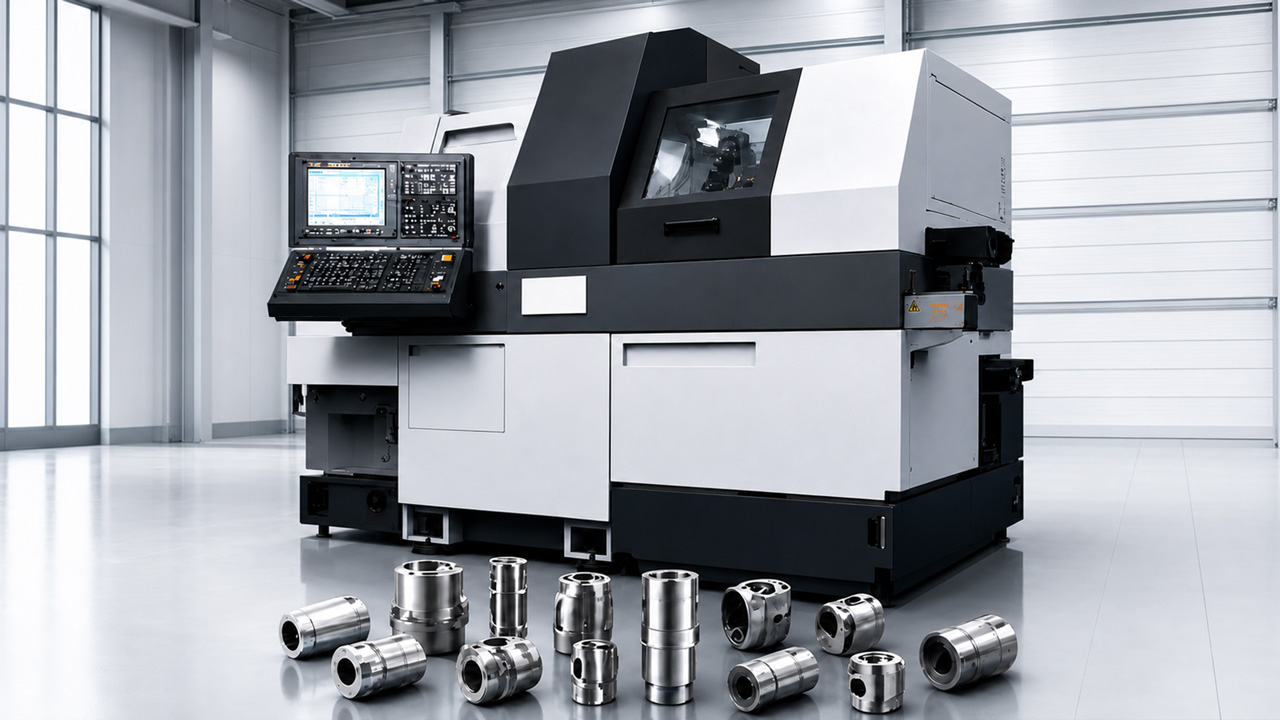
"So what, specifically, can a CNC automatic lathe machine?" — that is the next question every newcomer asks. This page introduces, as concretely as possible, the types of machining a CNC automatic lathe can perform, the parts it can make, and the materials it can cut. Use it as a guide to judging whether your own parts could be made on one.
In This Article
Types of Machining on a CNC Automatic Lathe
A CNC automatic lathe centers on turning (rotating the material and cutting it), but it can combine many other operations in a single machine. Here are the main ones.
Turning with single-point tools — the basic lathe operations of cutting outside diameters, end faces, and grooves. Front-end work (drilling family) — drilling, reaming, and boring holes on the centerline of the material. Cross machining — using rotating tools to drill from the side, mill flats (D-cuts), or perform other milling. Threading — cutting external and internal threads, or thread whirling for special threads such as those used in medical parts. B-axis machining — tilting the tool for angled holes and complex simultaneous multi-axis work. Hobbing — cutting gear teeth on outside or inside diameters.
By combining these, a complex finished part can be machined from bar stock in one pass.
What Parts Can Be Made
The CNC automatic lathe excels at small, slender precision parts with round features. Specifically, it produces parts across a wide range of fields: antenna and filter parts for 5G communications; medical parts (implants, endoscope components, bone screws); connectors and manufacturing-equipment parts for semiconductors and data centers; automotive parts (for engines, transmissions, power steering, airbags, brakes, and sensors); and aerospace fasteners.
In one sentence, its strongest territory is making large quantities of small, round, identical parts (shafts and screws) from long, thin metal bar.
Materials That Can Be Machined
A CNC automatic lathe can machine a wide range of materials. Broadly, these are ferrous metals (carbon steel, stainless steel, alloy steel), non-ferrous metals (aluminum, copper, brass, titanium), and non-metals (plastics and similar).
Machinability varies greatly by material: aluminum and free-cutting steel cut easily, while stainless steel and titanium are "difficult-to-cut materials" that require extra care. For difficult materials, adjusted cutting conditions and technologies such as oscillation cutting and high-pressure coolant come into play.
Typical Precision
CNC automatic lathes — Swiss-types especially — are capable of micron-level precision. The precision required varies by part, but the micro-components used in leading-edge fields such as medicine and semiconductors demand extremely tight accuracy, and meeting it is the Swiss-type's strength. Whether a specific part can be machined, and to what precision, depends on its shape, material, and the machine model, so the surest course is to consult the manufacturer.
"Can Do" Is Not the Same as "Good At"
We have covered a broad range of machining, but it is important to distinguish between what a machine can do and what it is good at. A CNC automatic lathe can perform many operations, but that does not mean it is the optimal choice for everything.
Where the CNC automatic lathe truly shines is in producing small, round precision parts in large volumes. Conversely, large block-shaped parts or parts dominated by flat-surface machining are better suited to a machining center. And for a single prototype, a conventional lathe may be quicker.
When choosing a machine, the question is not only "can this machine do it?" but "is this machine good at it?" If your main parts fall squarely within the CNC automatic lathe's strengths, its benefits are maximized. When weighing the fit with your own parts, also see Types & Structures.
Frequently Asked Questions (FAQ)
Q. Can a CNC automatic lathe make complex shapes?
A. Yes. By combining turning with cross drilling, milling, B-axis machining, threading, and more, it can machine complex finished parts from bar stock in a single machine.
Q. What materials can it machine?
A. A wide range: ferrous metals (steel, stainless steel), non-ferrous metals (aluminum, copper, titanium), and non-metals (plastics). Difficult-to-cut materials require some extra care.
Q. How large a part can it make?
A. It depends on the model, but generally from small diameters of a few millimeters up to medium diameters. It is especially strong on small, slender precision parts.
Summary
A CNC automatic lathe combines turning with drilling, milling, threading, B-axis work, and more, machining small, slender precision parts to high accuracy in volume, across ferrous, non-ferrous, and plastic materials. It is the machine behind parts for medicine, semiconductors, automobiles, and other leading-edge fields. Next, see Basics to Know Before You Buy for the points to consider when planning a purchase.