
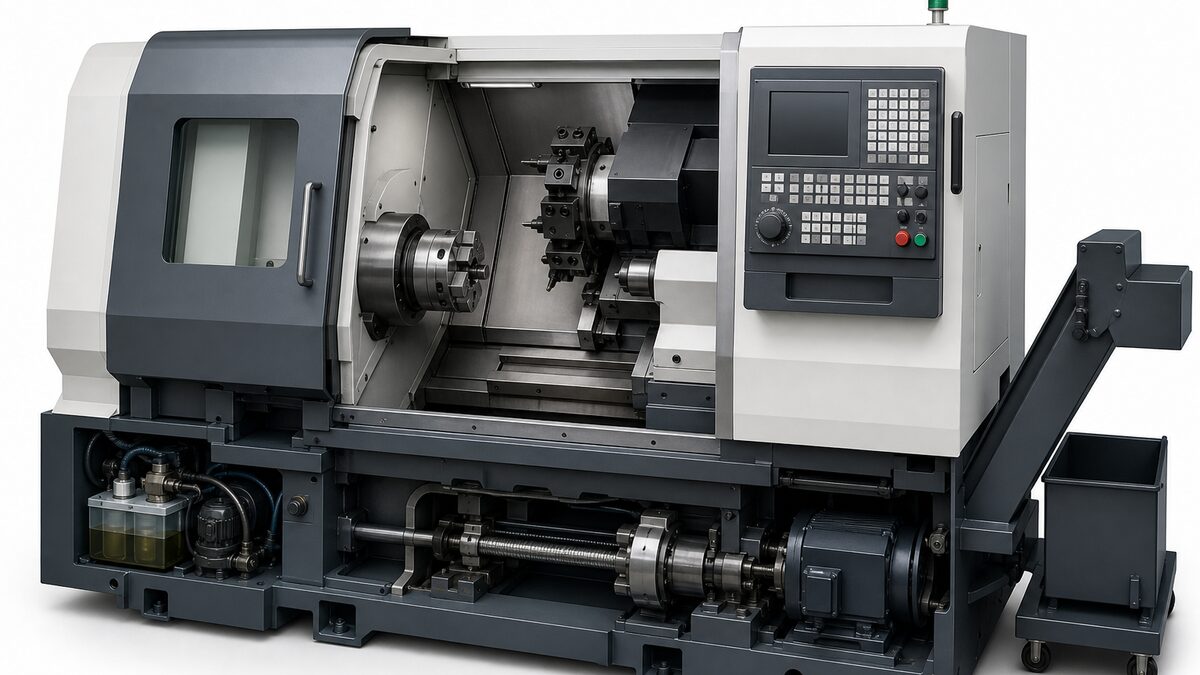
Buying a CNC automatic lathe is no small investment. To avoid regret after the purchase, it is important to understand the whole picture in advance — not just the specifications of the machine itself, but the peripheral equipment, the costs, and the path to start-up. This page organizes the basics that anyone evaluating a purchase should know.
In This Article
① How to Think About Machine Selection
The first priority is to choose a machine that matches the parts you want to make. The starting point is to define the shape, material, precision, and production volume of your main parts. Long, slender parts point to a Swiss-type; thicker, shorter parts to a fixed-headstock machine; high-speed volume production of simple shapes to a gang-type machine; complex shapes to a turret-type — narrowing down the type from the characteristics of the part. See Types & Structures for details.
② Peripheral Equipment You Will Need
A CNC automatic lathe cannot run unattended on its own. It has to be planned as a set with its peripherals: a bar feeder to supply bar stock, a conveyor to carry away chips, a coolant system to circulate cutting fluid, and a device to collect finished parts.
Installing the machine also requires preparation on the factory side — adequate floor space, power supply, and compressed air, among others. Overlook these and you may find after delivery that the machine cannot be installed or cannot run unattended.
③ Running Costs
Beyond the purchase price, be sure to understand the ongoing costs of operation. The main ones are tooling, cutting and lubricating oils, electricity, consumables and maintenance parts, and maintenance service.
Tooling costs in particular vary greatly with the work. If you machine a lot of difficult-to-cut materials, tools wear quickly and tooling costs can mount up. Estimating approximate running costs before purchase makes the investment decision much easier.
④ The Path to Start-Up and Setup
A CNC automatic lathe is not a machine that goes straight into volume production the moment it is installed. To actually make parts, preparation (setup) is required: understanding the drawing, writing the machining program, setting the tools, loading the material, and making trial cuts. How accurately this setup is done is the key to successful unattended operation.
Because setup demands a certain level of skill, operator training and making use of the manufacturer's support and technical information are also important factors in a smooth start-up.
⑤ Consider Subsidies Too
Purchasing a CNC automatic lathe may qualify for subsidies and grants that support labor savings and productivity improvement. As a way to reduce the burden of capital investment, it is worth looking into these early in the planning process. See the Subsidies & Support guide for details.
Plan for Operators: Hiring and Training
Easily overlooked, but worth deciding before you buy, is the question of who will run the machine. Because a CNC automatic lathe demands a certain level of skill in setup and programming, having — or developing — operators who can handle it is a precondition for stable operation.
If you already have experienced staff, that is reassuring; if you will be training people from scratch, you will need time and a structure for it. Manufacturer-provided operator training, technical information sites, and video manuals all help smooth the start-up. To avoid the situation where "the machine is in, but nobody can really use it," prepare your people in parallel with evaluating the equipment. Our Automatic Lathe Primer for New Hires can also be used in training younger staff.
Frequently Asked Questions (FAQ)
Q. How should I choose a machine?
A. The basic approach is to define the shape, material, precision, and production volume of your main parts, then narrow down to the matching type (Swiss-type or fixed headstock, tool post style, and so on).
Q. What do I need besides the machine itself?
A. Peripheral equipment such as a bar feeder, chip conveyor, and coolant system, plus factory-side preparation: floor space, power supply, and compressed air.
Q. Can I start volume production right after installation?
A. No. Setup is required — programming, setting tools and material, and trial cuts. Operator training and manufacturer support help the start-up go smoothly.
Summary
When buying a CNC automatic lathe, it is important to have five things in hand beforehand: machine selection, peripheral equipment, running costs, the setup required for start-up, and the use of subsidies. Evaluating the whole picture rather than the machine alone leads to a purchase you will not regret. Next, see An Automatic Lathe Primer for New Hires for younger shop-floor staff, or Types & Structures to compare machine types.